Aquarium and Koi Pond Maintenance Space Office Home in Chennai
Aquariums and koi ponds are living systems, and living systems drift. Water chemistry moves, filter media clogs, algae takes hold, equipment quietly stops performing before it visibly fails. None of this announces itself. By the time a tank looks wrong, the conditions that made it look wrong have usually been building for weeks.
Scheduled maintenance is how you stay ahead of that. We run annual maintenance contracts and service visits across Chennai, for tanks and ponds we built and for plenty we did not.
Two services, one page. Aquarium maintenance is covered first, then koi pond maintenance. They need different work on different schedules, so skip to whichever applies to you.
Aquarium Annual Maintenance Contracts
An annual maintenance contract is scheduled, repeating care for your aquarium on a fixed cycle, with the same technician learning your system over time. It is not the same thing as booking a cleaning, and the difference matters more than the name suggests.
A one-off cleaning treats appearance. Someone arrives, removes visible algae, changes some water and leaves. The tank looks better that afternoon. Nothing about the conditions that produced the algae has changed, so it returns on the same timetable it did before.
A contract treats the system. Water is tested rather than eyeballed, so a problem shows up as a number before it shows up as a dead fish. Filter media gets rotated on a schedule rather than replaced when flow has already dropped. Equipment is checked while it is still working. Records accumulate, so a slow drift in pH over four months is something we can see rather than something that happens invisibly.
The practical difference for you is that a maintained tank rarely has dramatic days. Fish losses cluster around water quality events, and water quality events are largely preventable with testing and consistency.
We maintain freshwater, planted and marine systems, and we take on tanks built by other people. There is no obligation for us to have built it.
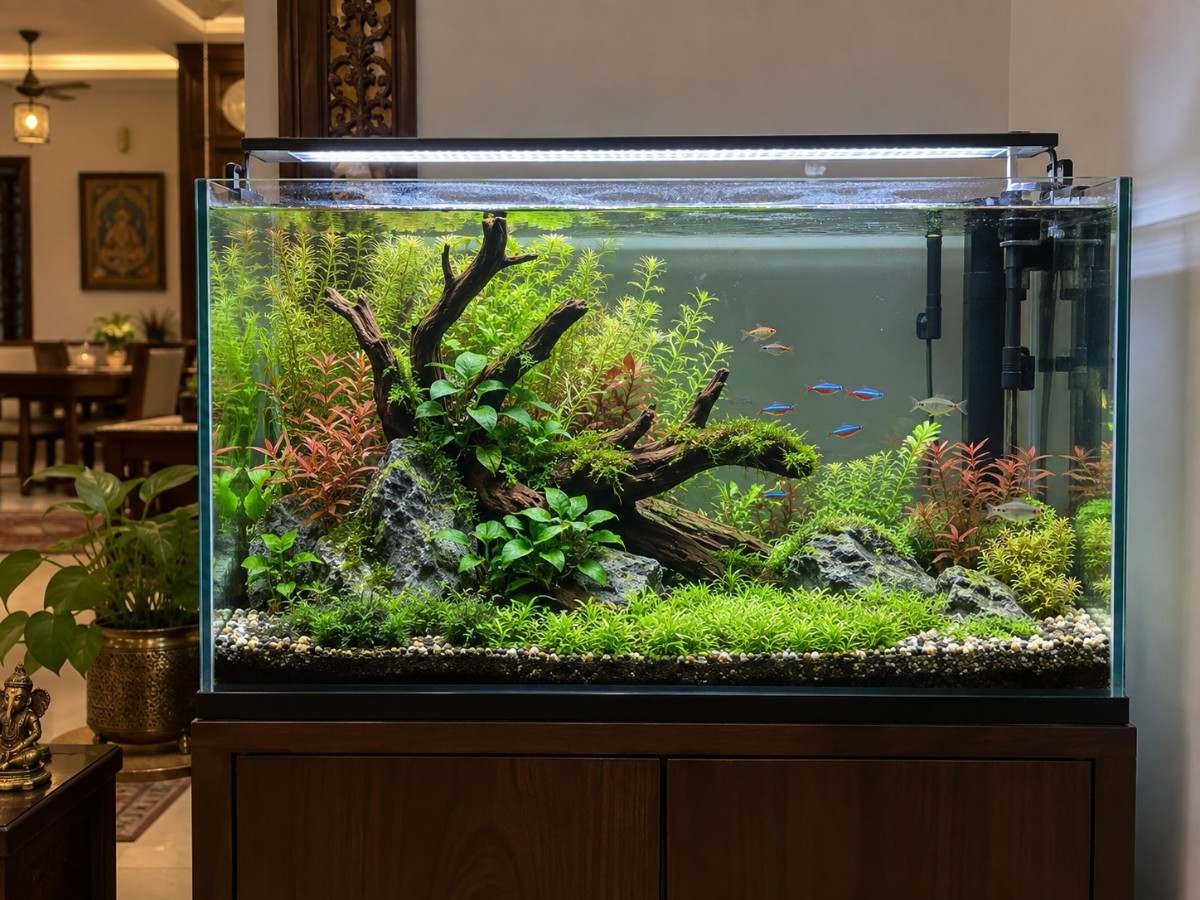
What an AMC Includes
Water testing and correction. Ammonia, nitrite, nitrate and pH as standard, with hardness and TDS where the system or the water supply calls for it. Results are recorded, not just read. Where a parameter is drifting, we correct it and note what caused it.
Partial water change. Sized to the tank and its stocking, using treated water. Never a full change, which would destroy the bacterial population doing your filtration.
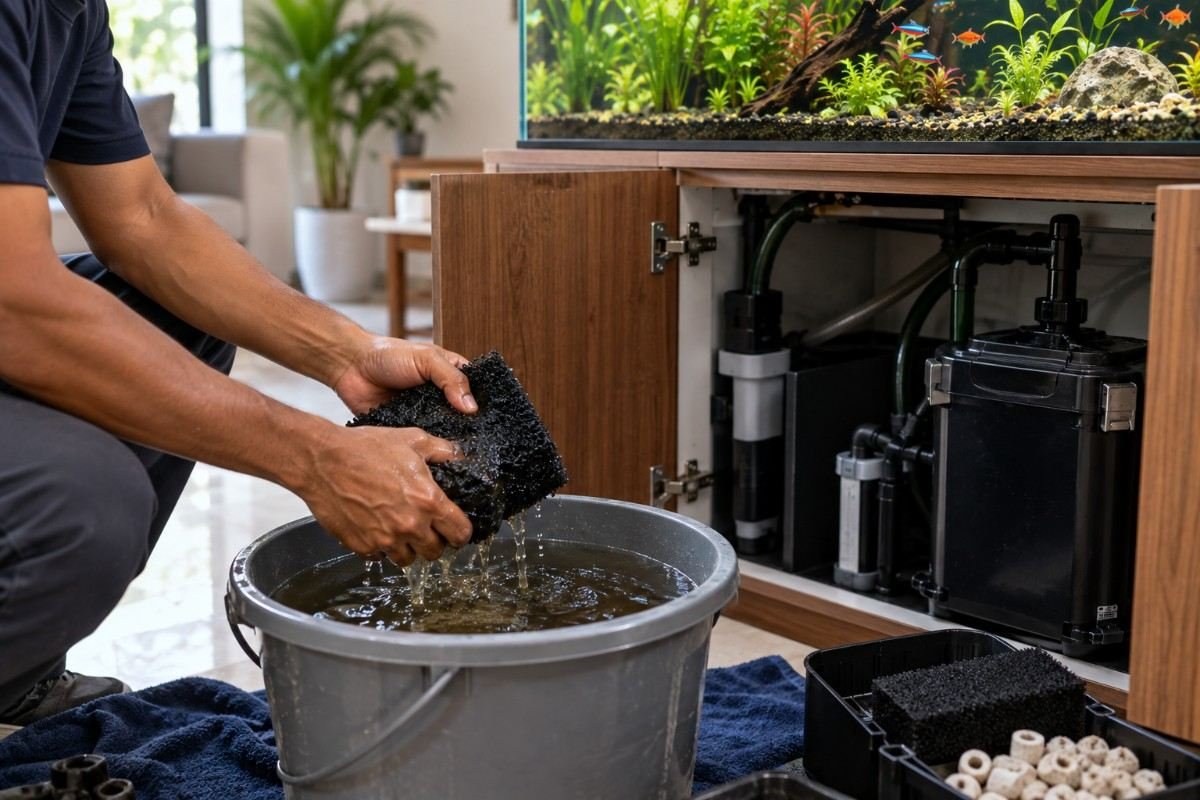
Mechanical filter servicing. Sponges, floss and pre-filters cleaned or replaced as needed.
Biological media care. Rinsed in tank water rather than tap water, because chlorinated water kills the nitrifying bacteria that keep ammonia at zero. This sounds like a small detail. It is the most common way a well-intentioned cleaning crashes a tank.
Glass or acrylic cleaning, inside and out, with tools appropriate to the material. Acrylic gets different treatment from glass, covered below.
Algae management, including identifying which type you have, since the causes and remedies differ.
Equipment check. Filters, pumps, heaters, chillers, lighting and timers inspected for function and wear, with anything deteriorating flagged before it fails.
A written service record left with you or emailed, showing what was tested, what the readings were and what was done. Equipment replacement, medication and livestock are quoted separately rather than bundled, so you are never paying a contract premium against parts you may not need.
How Often a Tank Needs Servicing
Most domestic aquariums need a professional visit monthly, with heavily stocked, marine or commercial systems better served fortnightly. Between visits there is light daily and weekly work that owners usually handle themselves, and we show you exactly what that is at handover.
Frequency follows fish load and system type rather than tank size. A large, lightly stocked planted tank can be more stable than a small tank with too many fish in it, because stability comes from the ratio of water volume to waste production.
Marine and reef systems need closer attention than freshwater. Their parameters move faster, the livestock is less tolerant of swings, and the equipment list is longer.
New tanks need more frequent early visits while the biological filter establishes, then settle into a normal cycle.
We will recommend a schedule after seeing the system rather than selling you a tier off a list. If a monthly visit is genuinely enough for your tank, we will say so.
What Aquarium Maintenance Costs
Worth being direct about how this market prices, because you will see two very different numbers while shopping.
Per-visit cleaning is widely available in Chennai at low rates. That service is what it costs to be: a person, an hour, a bucket and no testing. If your tank is small, lightly stocked and forgiving, it may be all you need, and we would rather tell you that than talk you into a contract you will resent.
Contract pricing works differently, because what you are buying is different. A contract is priced against tank volume, system type, stocking level, visit frequency and travel. It includes testing, record keeping, media, and a technician who knows your system rather than whoever is available. For a large, valuable or commercial tank, that consistency is the entire point, and the cost of a maintenance contract is small against the cost of restocking a crashed reef or explaining a cloudy lobby tank to your management.
The honest summary: if price per visit is your deciding factor, a contract is not the right product for you. If keeping a specific tank healthy for years is the goal, it is.
How Often a Tank Needs Servicing
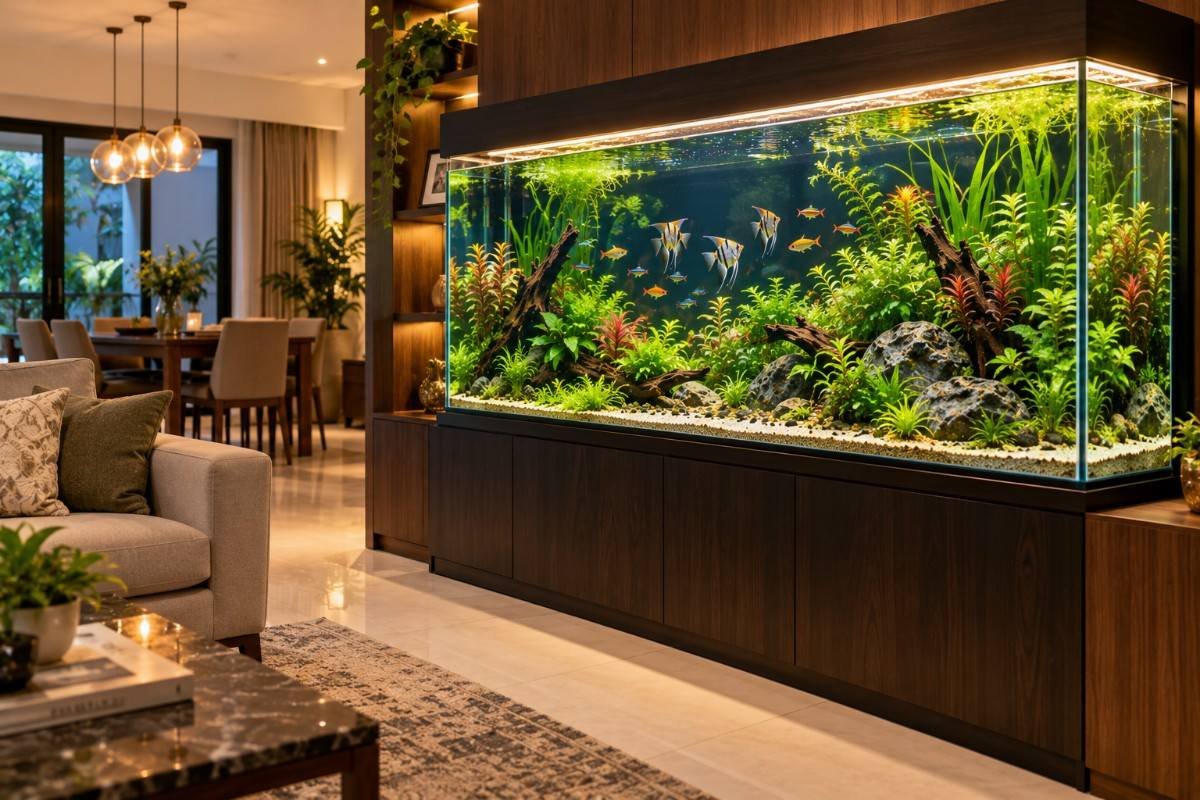
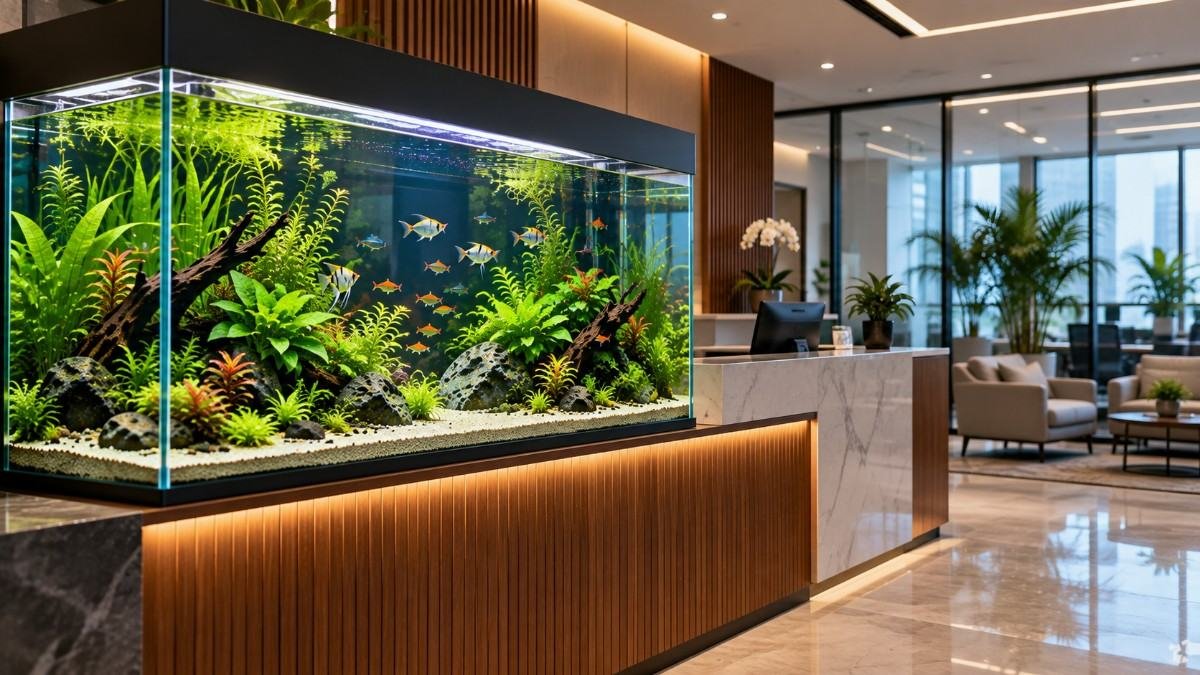
A commercial aquarium is a different job from a domestic one even at identical volume, because it carries obligations a home tank does not.
It is seen by customers, so presentation standards are absolute. A home tank with a slightly algal panel is a minor annoyance. A hotel lobby tank in the same condition is a visible statement about the property, noticed by every guest who walks past it.
It cannot go offline during business hours, so servicing has to fit around your operating pattern rather than the other way round.
It needs accountability. Commercial clients should expect a written water test log at every visit, so trends are visible and anyone can audit what has been done. We provide that as standard on commercial contracts.
And it needs a defined response time for problems, because a failed chiller in a reef system or a pump failure in a stocked tank is not something that can wait for the next scheduled visit.
We service aquariums in hotels, restaurants, corporate offices, clinics, hospitals and showrooms across Chennai. Scheduling is agreed against your hours, including early morning or after-hours slots where public areas cannot be worked in during the day.
Servicing Large Acrylic Tanks
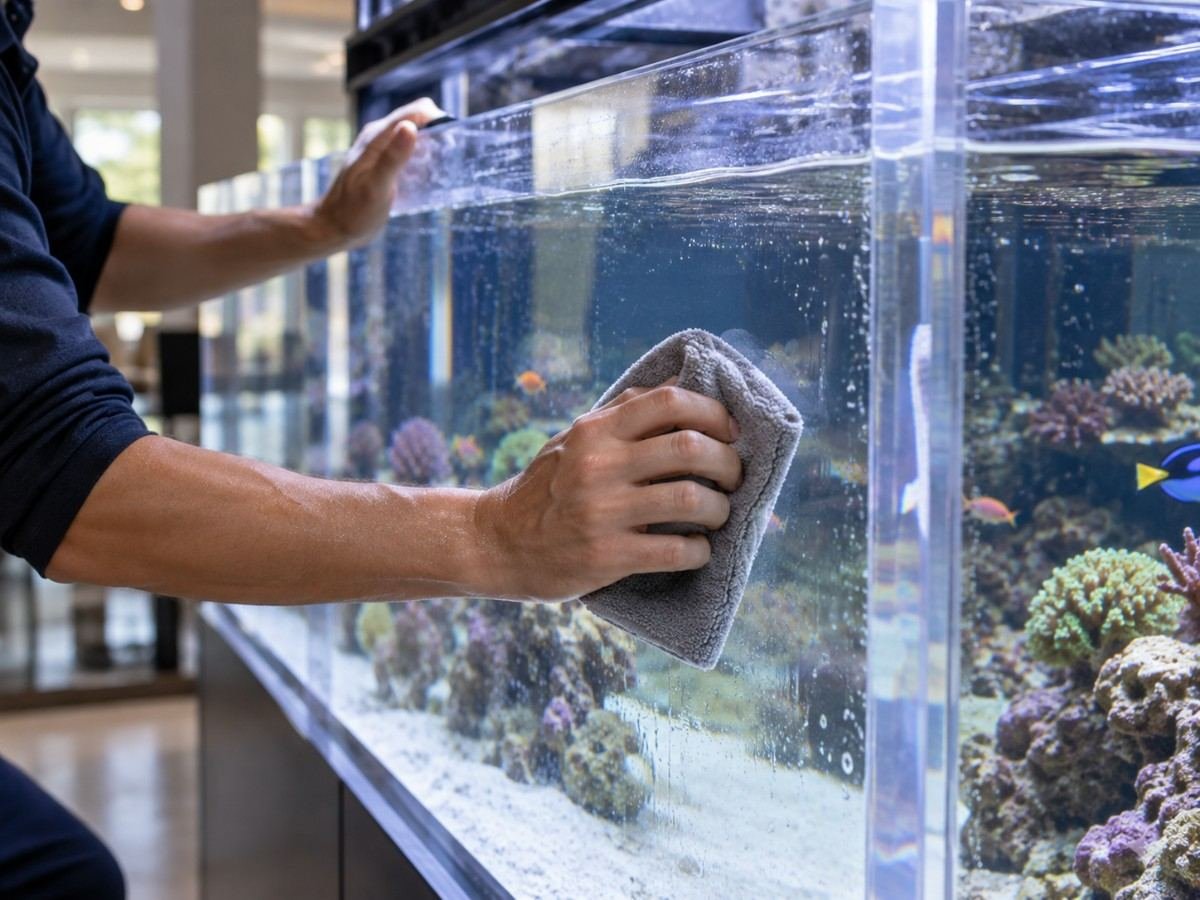
Acrylic needs different handling from glass, and this is where non-specialist cleaning does expensive damage.
Acrylic is a softer material. A magnetic scraper or pad that is perfectly safe on glass will mark acrylic, and a single grain of sand trapped under a cleaning pad will cut a visible arc across a panel in one stroke. Ammonia-based cleaners and solvents, standard for glass, cause crazing and clouding on acrylic that cannot be reversed.
Correct servicing means acrylic-specific pads and scrapers, no abrasives, no ammonia cleaners, and a technician checking the pad for grit before every pass rather than after the damage.
The upside is that acrylic scratches can be polished out, which is not true of glass. We polish out light scratching on acrylic tanks as part of contract work where it is worth doing, and quote separately for heavier restoration.
If you have a large acrylic tank currently serviced by a general cleaning crew, it is worth having the panels looked at. Scratch damage accumulates gradually and is often not noticed until the viewing panel has lost clarity across the whole face.
What Commercial Clients Should Ask For
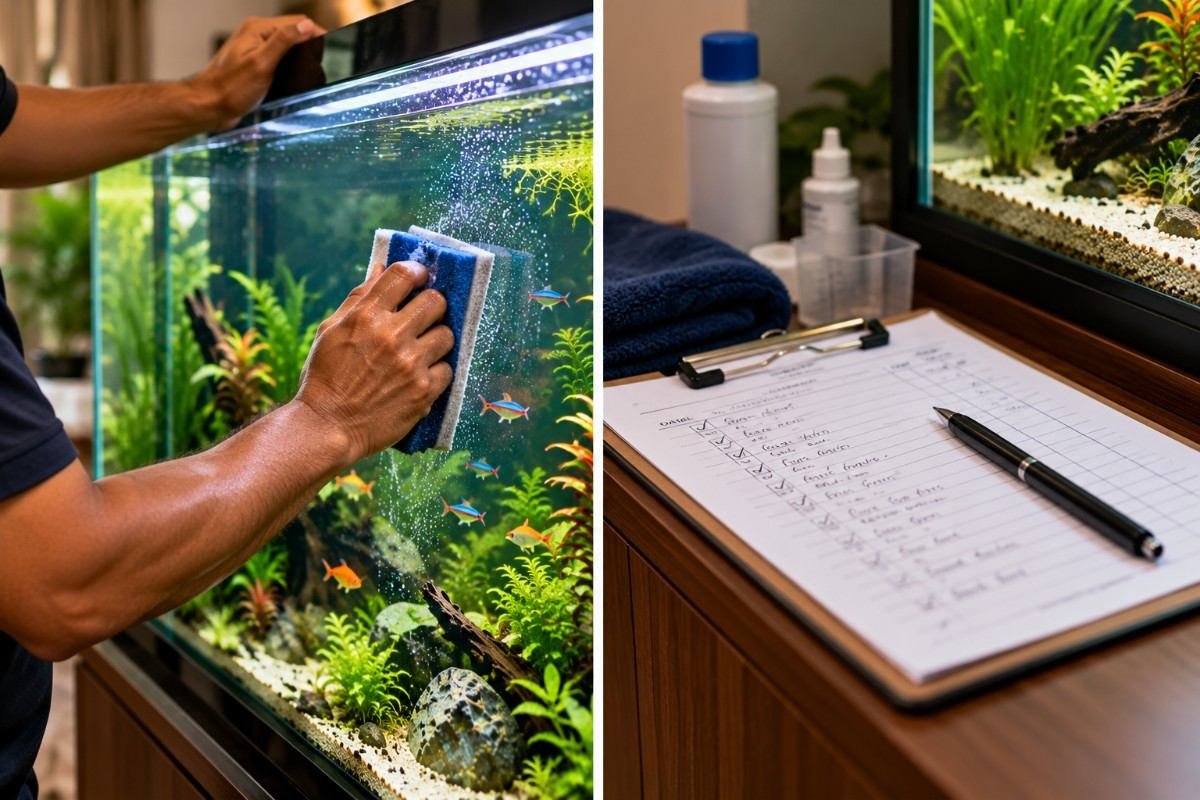
Whoever you appoint, including us, these are worth requiring in writing.
A written water test log at each visit. A defined response time for emergency callouts. A named technician rather than whoever is rostered. Clarity on what is included versus chargeable, particularly livestock and equipment. Servicing hours agreed against your operating hours. And a handover procedure if the contract ends, so your system's history goes with it.
If a prospective supplier cannot commit to those, that tells you what kind of service you are buying.
Start an Aquarium AMC
Tell us the tank: volume, whether it is freshwater, planted or marine, roughly what is in it, and where it is. For commercial enquiries, tell us your operating hours and whether public access constrains when we can work.
We will look at the system, recommend a visit frequency and quote a contract. If your tank does not need one, we will tell you that too.
Aquarium Maintenance Questions
What is included in an aquarium annual maintenance contract?
A scheduled visit covering water testing for ammonia, nitrite, nitrate and pH, a partial water change with treated water, mechanical filter cleaning, biological media rinsed in tank water, glass or acrylic cleaning, algae management, an equipment check across filters, pumps, heaters and lighting, and a fish and plant health check. You also get a written record of readings and work done at each visit. Equipment replacement, medication and livestock are quoted separately rather than bundled into the contract.
How often should an aquarium be professionally serviced?
Monthly for most domestic tanks, fortnightly for heavily stocked, marine or commercial systems. Frequency follows fish load and system type rather than tank size, because stability depends on the ratio of water volume to waste production. New tanks need closer attention while the biological filter establishes. Owners typically handle light weekly tasks between professional visits.
What is the difference between aquarium cleaning and an AMC?
What is the difference between aquarium cleaning and an AMC? Cleaning addresses appearance on the day. Someone removes visible algae, changes some water and leaves, and the conditions that caused the algae are unchanged. An AMC addresses the system: water is tested so problems appear as numbers before they appear as symptoms, media is serviced on a schedule, equipment is checked before it fails, and records accumulate so slow drifts become visible. Cleaning is a transaction. A contract is a maintained system.
Can I maintain a large aquarium myself?
Many owners do, and we are happy to hand over a system properly and show you the routine. It becomes impractical at scale, with marine and reef systems, and where the tank is a commercial asset that cannot be allowed an off week. The most common self-maintenance mistakes are rinsing biological media in tap water, which kills the bacterial colony, and cleaning acrylic with the wrong pads or an ammonia-based cleaner, which marks the panels permanently.
Do you maintain aquariums you did not build?
Yes, and a large share of our maintenance work is on tanks built by others. We start with an assessment of the system, the equipment and the water, so we know what we are taking on, and tell you honestly if something in the setup needs correcting before a maintenance routine will hold.
Koi Pond Maintenance
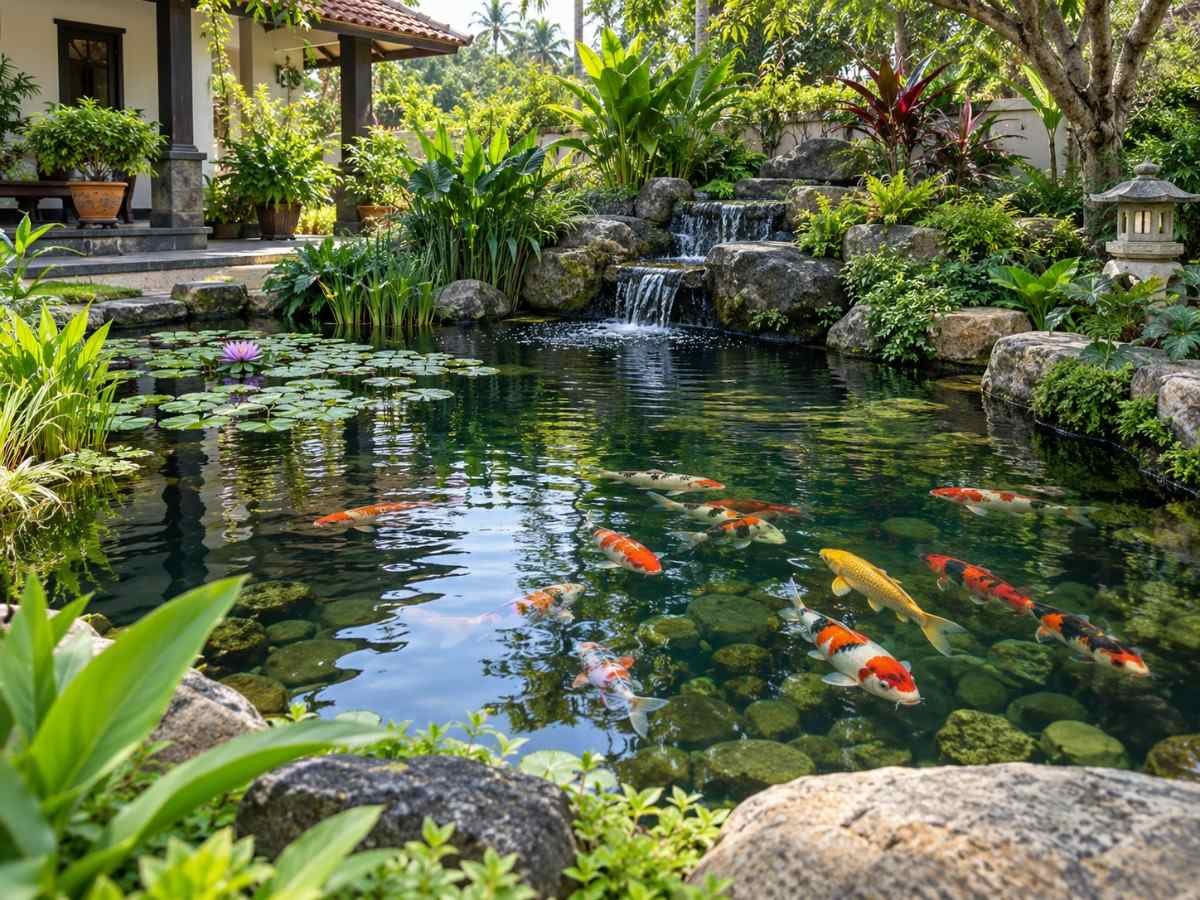
A koi pond is a larger, more exposed system than an aquarium, and it fails differently. Tanks tend to fail through water chemistry. Ponds tend to fail through accumulated solids, undersized filtration and seasonal stress, usually all three together.
We maintain koi ponds across Chennai on scheduled contracts and on individual service visits, including ponds built by other contractors. If your pond is struggling rather than simply due for a service, the diagnostic work is covered on our koi pond construction page, which deals with repairing poorly built ponds.
What an AMC Includes
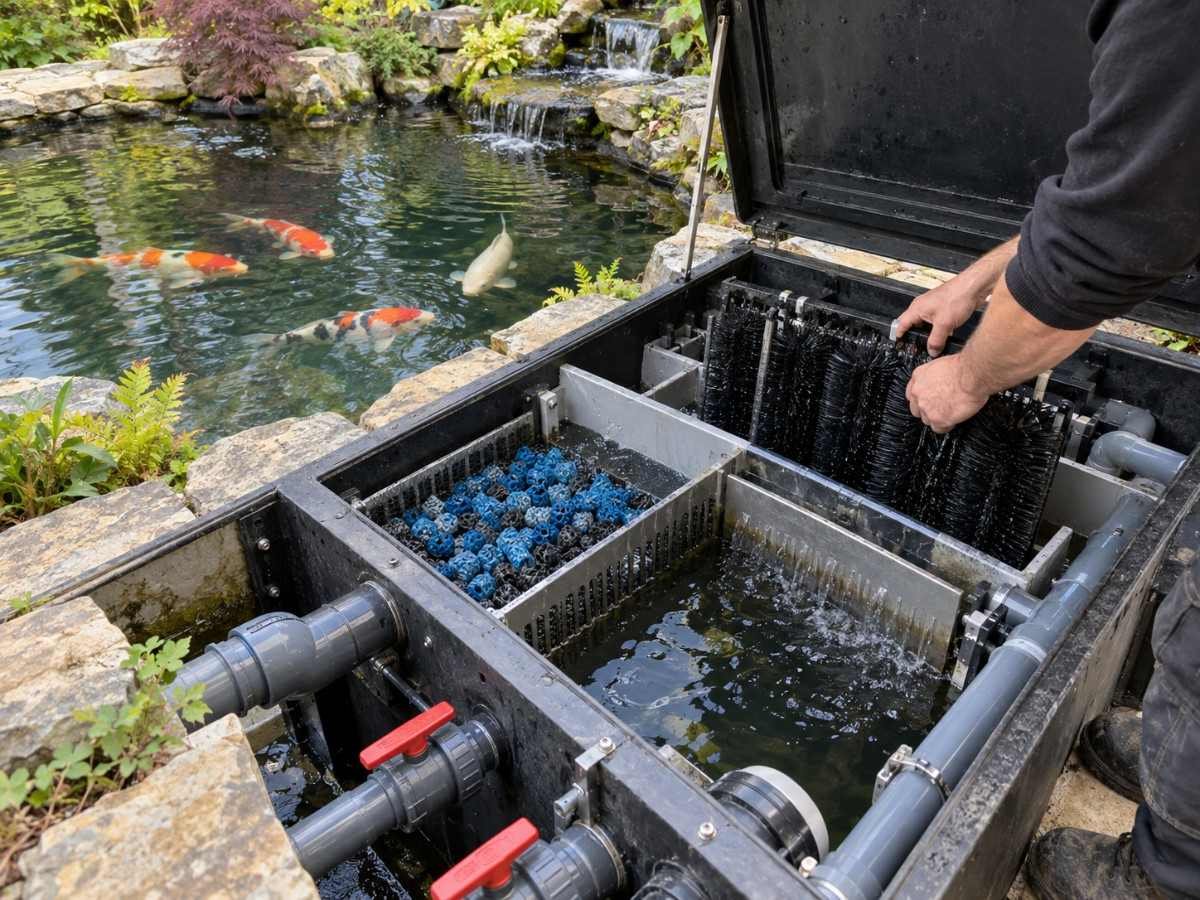
Filter servicing. Mechanical stages cleaned, biological media checked and rinsed in pond water. Never in tap water, for the same reason as aquariums: chlorinated water kills the bacterial colony.
Flow and equipment check. Pumps, UV units, aeration and plumbing checked for performance. A UV lamp that still lights can be well past its useful output, which is a common reason ponds start greening again after a year.
Solids and sludge removal. Settled waste is vacuumed from the pond floor and the settlement chamber is cleared. This is the single most important recurring job in pond care, because organic material left to decompose becomes dissolved waste, and dissolved waste is far harder to remove than solid waste.
Water testing. Ammonia, nitrite, nitrate, pH and hardness, recorded each visit.
Fish health check., Koi are observed for behaviour, feeding, and visible signs of parasites or injury.
Partial water change and top-up, with treated water.
Planting and edges trimmed and cleared, and skimmer baskets emptied.
Why We Do Not Drain Your Pond to Clean It
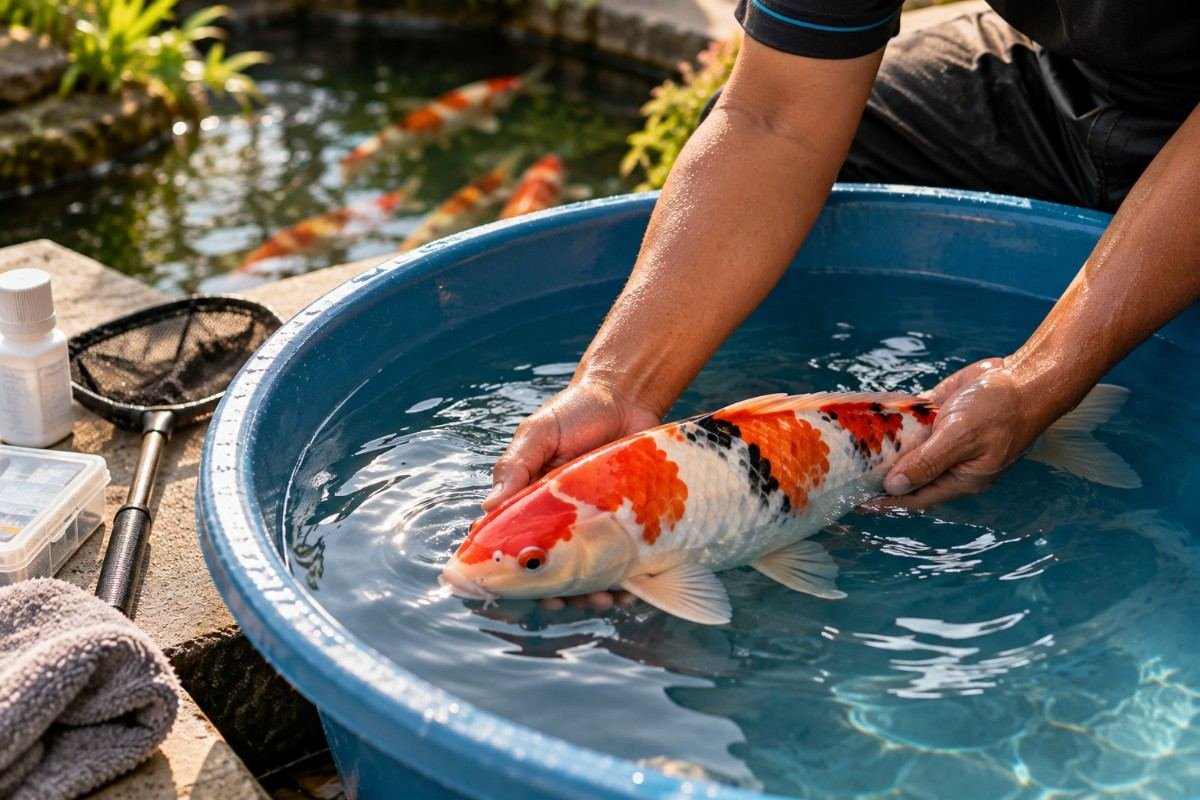
A koi pond should almost never be fully drained and pressure washed, and a contractor who proposes it as routine cleaning is about to reset your pond's biology to zero.
The surfaces inside a pond carry a biofilm of nitrifying bacteria. That film is not dirt. It is a substantial part of your filtration, built up over months, and it is doing the work of converting ammonia into something harmless. Pressure washing strips it off. What follows is a pond that looks immaculate for a week and then goes through an ammonia spike and an algae bloom as the biology rebuilds from nothing, frequently with fish losses along the way.
Removing fish adds a second risk. Koi are sensitive to temperature change, and moving them between water bodies with different temperatures is a known stressor. A shift of more than a few degrees inside a day is a real danger, and holding containers left in Chennai sun reach that difference quickly.
There are genuine exceptions. Structural repair, waterproofing failure, a serious contamination event or a disease outbreak requiring full sterilisation can all justify draining. Those are interventions with a specific reason, planned with fish housing and temperature matching handled properly. They are not maintenance.
Correct practice is partial, more frequent cleaning with the fish left in place: vacuum the settled solids, clear the filter stages, change a portion of the water, and leave the ecosystem intact. The pond stays slightly less than spotless and considerably more stable, which is the right trade.
Seasonal Pond Care in Chennai
Chennai gives a pond two distinct problems a year, and both are predictable enough to plan around.
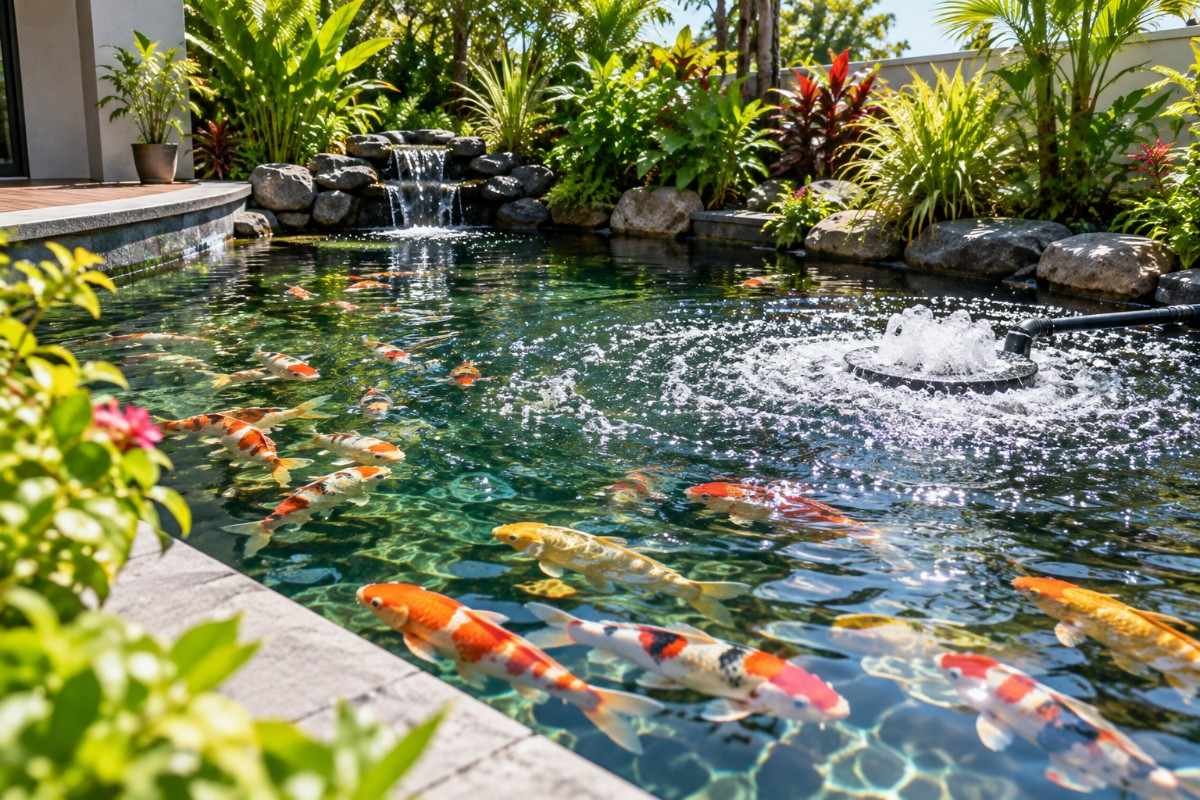
Through the hot months, evaporation rises and dissolved oxygen falls at exactly the time fish and filter bacteria are both consuming more of it. Top-ups become more frequent, aeration matters more than at any other time, and feeding usually needs reducing rather than increasing. Water level dropping in summer is normal. Water level dropping in December is a leak.
Through the monsoon, the risk reverses. Runoff carries debris, soil and whatever is on the surrounding surfaces into the pond, and heavy rain can shift pH and hardness quickly. Ground around the pond should drain away from it, not into it. After heavy rain, water parameters are worth checking rather than assuming.
Contract visits are weighted accordingly rather than spread evenly across the year.
What Pond Maintenance Costs
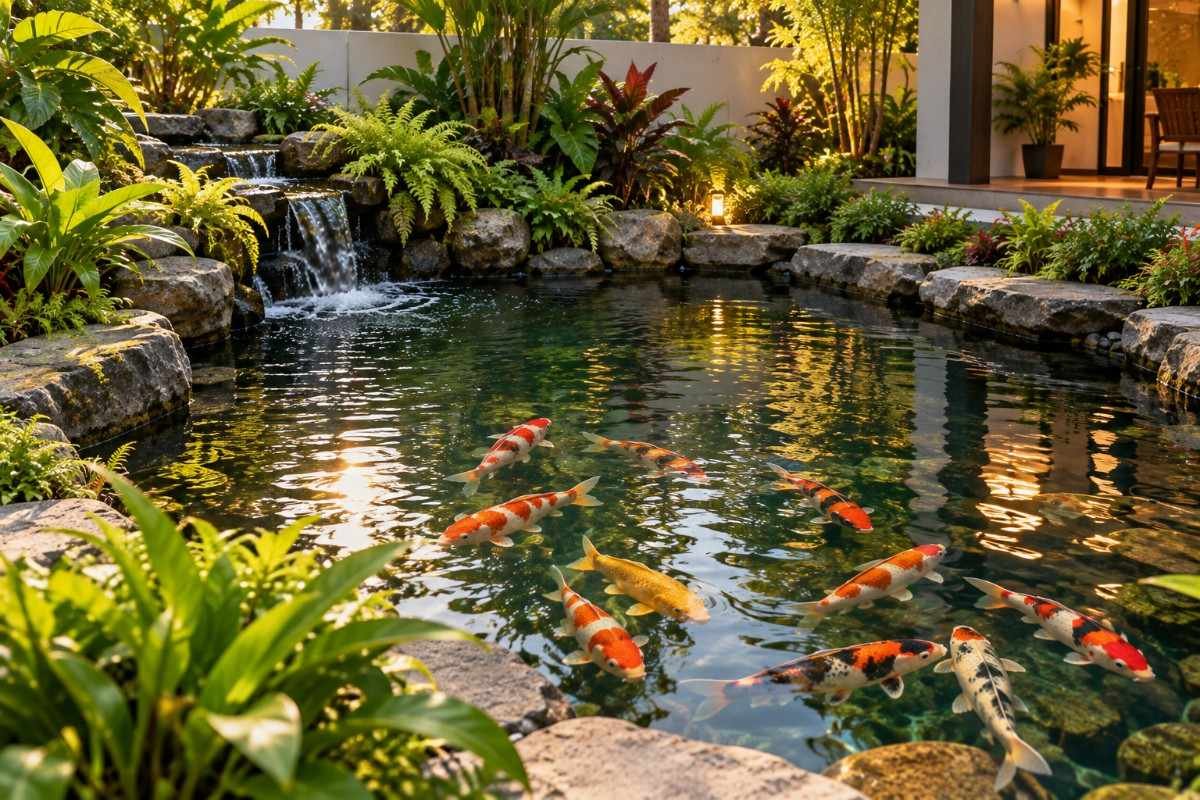
Pond servicing is priced on volume, filtration complexity, stocking and access, and on whether you want a scheduled contract or occasional visits.
A pond with a well designed gravity-fed filtration system takes less maintenance labour than one with undersized filtration, because a good system does more of the work continuously. This produces a genuine paradox worth knowing: the better your pond was built, the less it costs to maintain, and a poorly built pond is expensive forever. If yours falls in the second category, upgrading the filtration usually pays for itself against service costs.
Volume · Filtration complexity · Stocking · Access · Visit type
Book a Pond Service Visit
Tell us the pond: rough size and depth, what filtration it has if you know, how many koi, and where it is. If there is a current problem, describe it, since that changes whether you need a service visit or an assessment.
Water Chemistry and Fish Health
This applies to tanks and ponds alike, and it is the part of maintenance that is genuinely technical rather than simply diligent.
Almost every avoidable fish death traces back to water. Ammonia and nitrite should both read zero in an established system, and anything above roughly 0.25 ppm of either is actively harmful. Nitrate accumulates as the end product of the cycle and is controlled by water changes and planting. pH matters less for its absolute value than for its stability, since a swinging pH stresses fish more than a steady value slightly off ideal.
Chennai adds a local variable most guidance ignores: what comes out of your tap varies enormously depending on which supply fills your tank. Metro Water and borewell water in this city can differ by several times in hardness and dissolved solids, and borewell supply in many areas is substantially harder. That changes how water should be treated before it goes in, and it is why we test your source water rather than assuming it. If your building switched from one supply to the other and your tank became unstable afterwards, that is very likely the cause and it is rarely diagnosed.
Municipal water also needs treating for chlorine and chloramine before it goes near fish or filter media. Chloramine in particular does not gas off by standing, which is the traditional advice and is no longer reliably true.
Algae is a symptom rather than a disease. It blooms when light and nutrients exceed what the system is removing, so the durable fix is adjusting the balance rather than scrubbing more often. Different algae types point to different causes, which is why identification comes before treatment.
When a Fish Is Already Sick
If fish are dying, gasping at the surface, sitting on the bottom, flicking against surfaces or showing visible marks, treat it as urgent and get in touch rather than waiting for a scheduled visit.
The first step is always water testing, because a large share of what looks like disease is water quality, and medicating a water problem makes it worse by adding another chemical stressor to an already stressed fish. We test first, then identify.
Genuine disease and parasites are treatable, and in koi in particular the value of the fish usually justifies proper diagnosis rather than a broad-spectrum treatment bought over a counter. Treatments carry dosing and species sensitivities that are easy to get wrong, and an overdose in a stocked pond is difficult to undo.
We offer emergency callouts for existing contract clients as a priority, and to others as availability allows.
Areas We Cover and How Scheduling Works
We service the Chennai metropolitan area, and where you are affects scheduling more than most people expect, so it is worth explaining rather than simply claiming coverage.
Maintenance visits run as routes. We group visits by area and work each zone on set days, which keeps travel down and lets us hold contract pricing at a sensible level. When you take a contract, you are assigned to the route covering your area, which is why your visit day tends to be consistent month to month.
In practice we run regular routes through the central and southern corridors, covering Adyar, Velachery, T Nagar, Anna Nagar, Besant Nagar and the OMR and ECR stretches, along with the surrounding neighbourhoods. Areas with denser client clusters get more frequent route days, which also means faster emergency response, since there is a reasonable chance a technician is already working nearby.
If you are outside the regular routes, we still take the work. It may mean less flexibility on which day your visit lands, and travel may be reflected in the quote.
For commercial sites with fixed access windows, tell us the constraint at enquiry stage. Scheduling around a hotel's quiet hours or an office's weekend access is normal, but it needs to be built into the route rather than requested afterwards.
Designs, builds and maintains custom aquariums, koi ponds and aquatic features with a focus on thoughtful engineering and long-term care.
SUBSCRIBE FOR UPDATE
©Living Art Aquarium 2026. All rights reserved.