
Aquarium and Koi Pond Maintenance Space Office Home in Chennai
A koi pond is a filtration system with water features attached, not a water feature with fish in it. That distinction decides whether you end up with a pond that stays clear for years or one that turns green every summer and gets emptied within two.
Most failed ponds in this city were built by people who got the civil work right and the water engineering wrong. The shell holds water, the waterfall looks good, and then the filtration cannot cope with the fish load, the pond is too shallow for Chennai's heat, and the owner spends the next three years fighting the water.
Living Art Aquarium has been building koi ponds and their life support systems in Chennai for over two decades. We design the filtration first and build the pond around it.
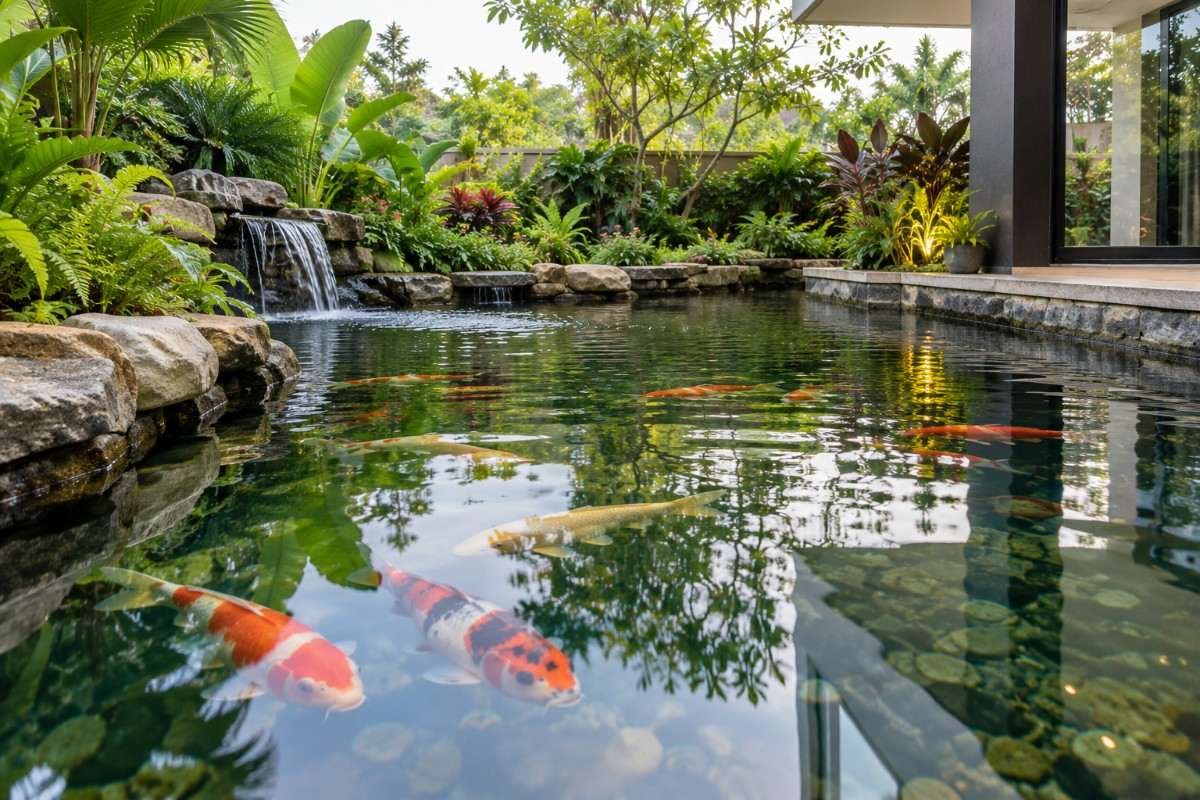
Types of Koi Pond We Build
The three formats below cover most of what gets built in Chennai homes and commercial spaces. The engineering underneath is broadly the same in each. What changes is the setting, the viewing angle and the constraints the site puts on you.
Outdoor and Garden Ponds
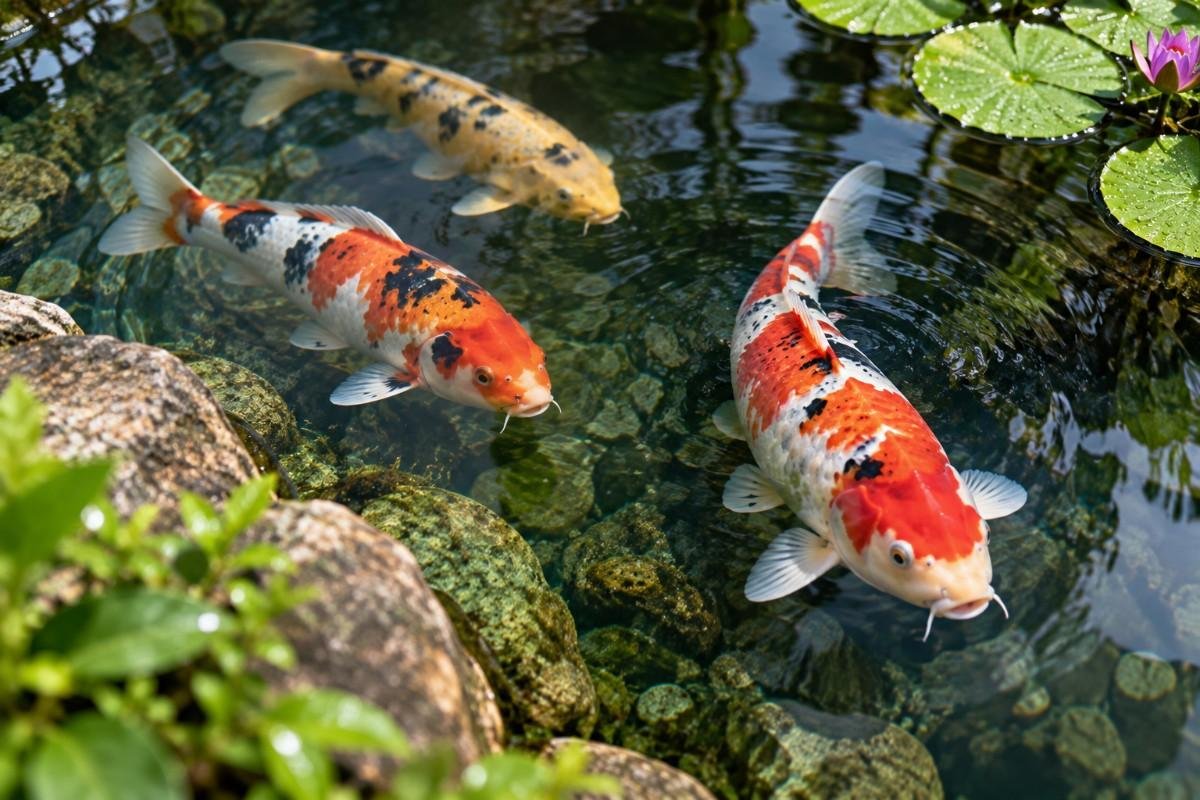
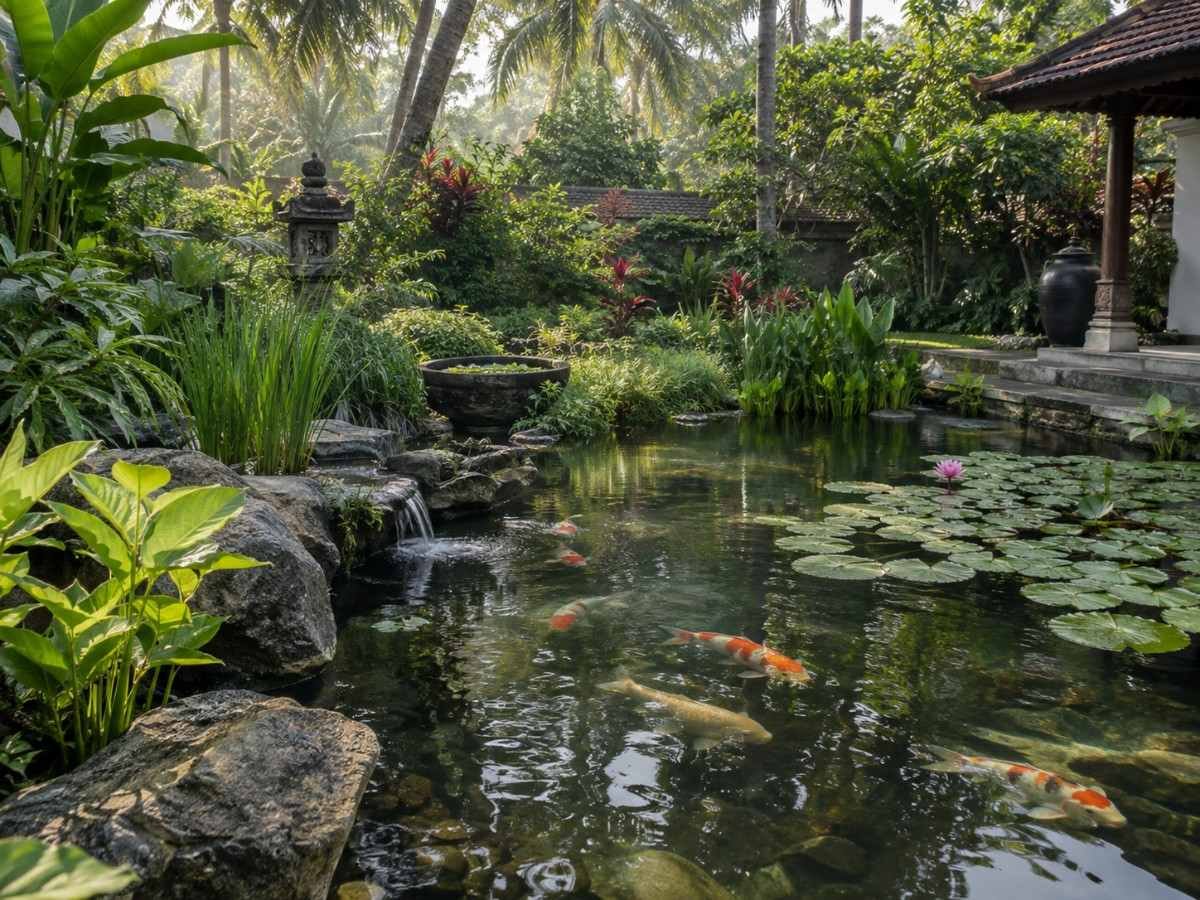
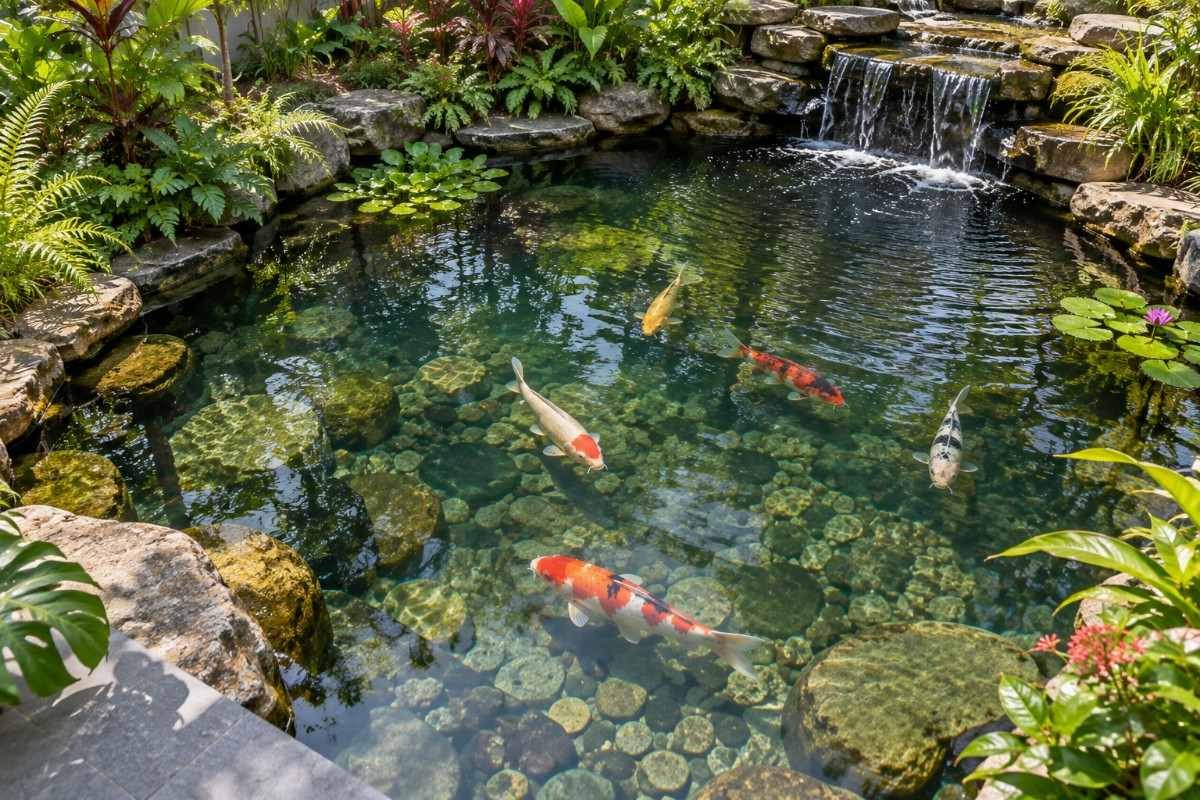
The classic format, and the one that suits Chennai plots best. An outdoor koi pond sits in a garden, a courtyard or a setback, usually with planting around it and often with a waterfall or cascade at one end.
Outdoors you have room for depth, which matters more here than in most climates. You also have room to put the filtration where it belongs, in a chamber beside or below the pond rather than squeezed into whatever space is left. Natural daylight is good for koi colour development, though it also drives algae, which is a filtration and shading question rather than a reason to avoid it.
The main site constraint is drainage and water table. We check both before design, because a pond excavated into ground with a high water table needs a different approach from one in firm soil.
Indoor Ponds and Entrance Water Features
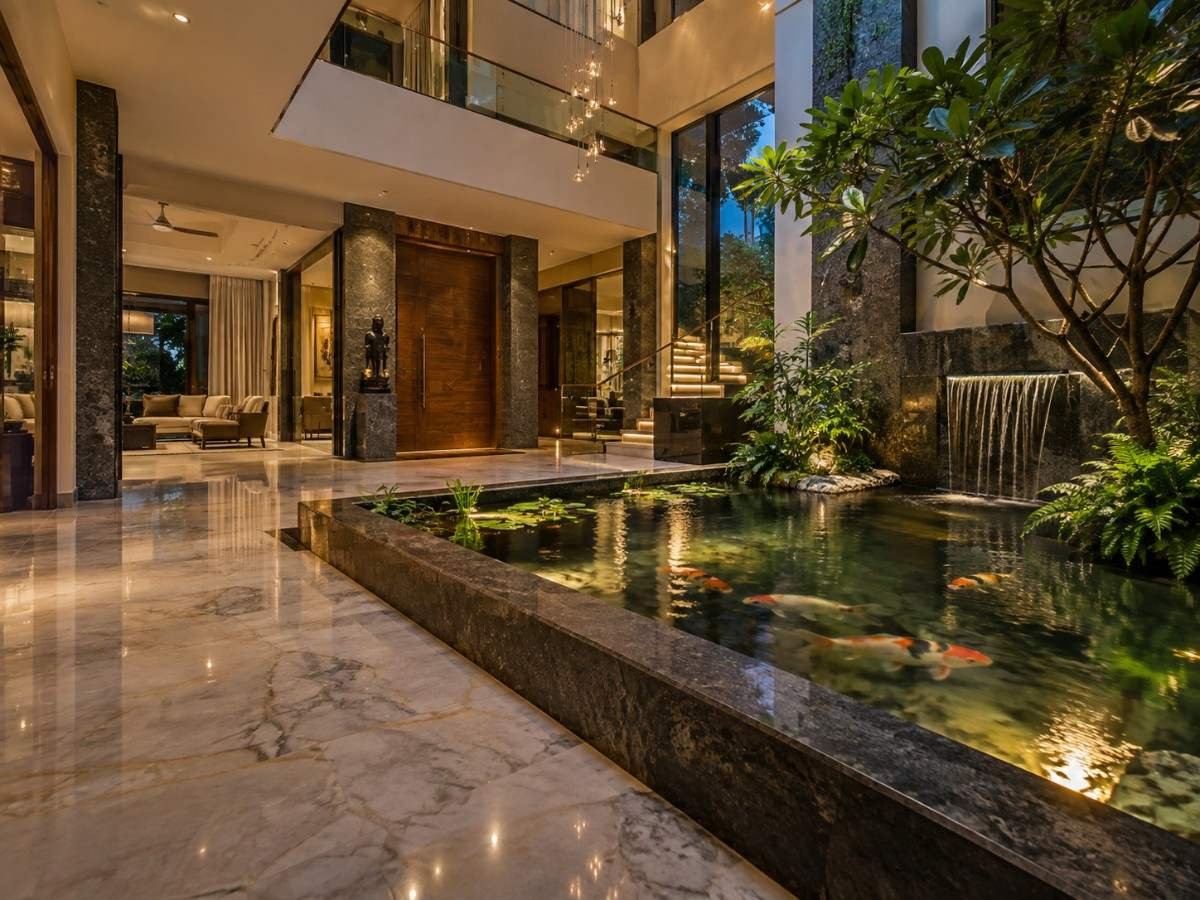
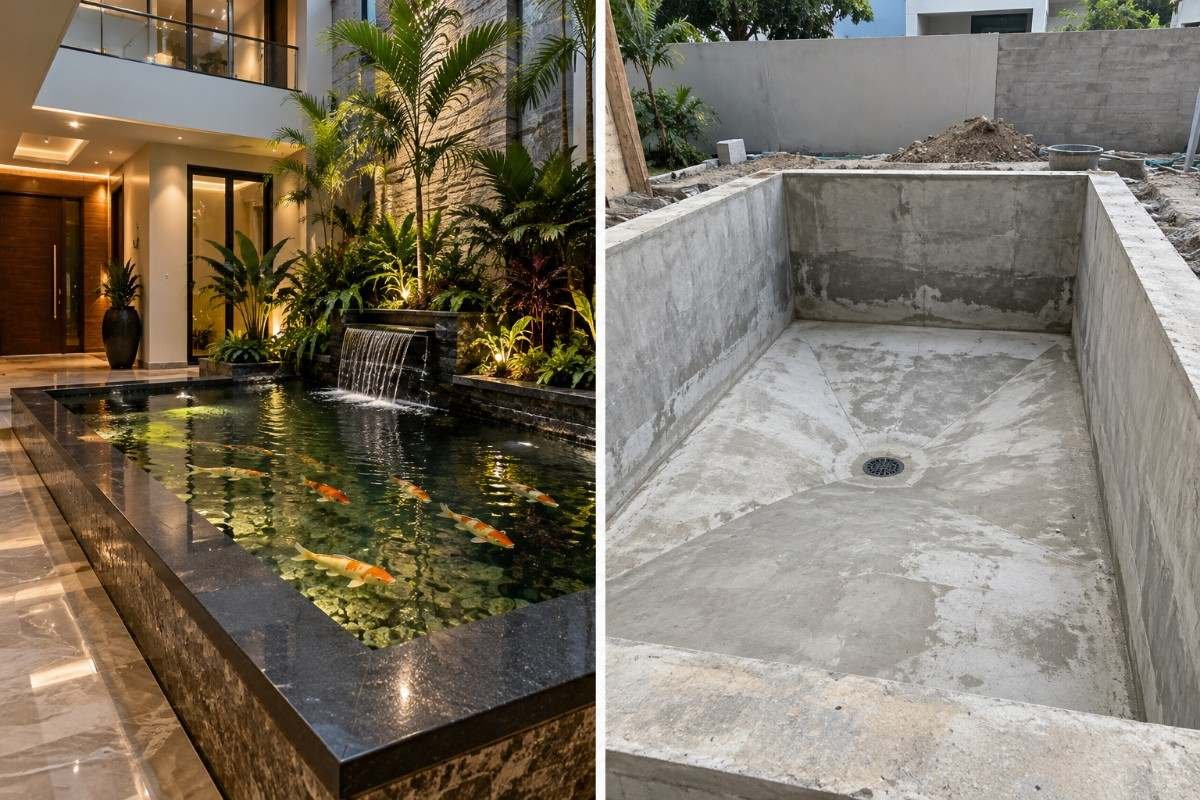
An indoor koi pond in a home entrance, atrium or lobby is one of the strongest architectural statements you can make with water, and it is increasingly common in Chennai villas and commercial receptions.
Indoors the constraints tighten. You are working to a fixed floor level, so the pond is usually raised or partially raised rather than fully excavated. Filtration has to be concealed and quiet. Humidity and splash need planning, because an indoor water body changes the environment around it in ways an outdoor one does not. Lighting is artificial and has to be specified for both the fish and the way the pond will be seen.
Indoor ponds can run slightly shallower than outdoor ones, because they are not exposed to direct sun and the water temperature is more stable. They still need proper depth for the fish.
Ponds With an Acrylic Viewing Window
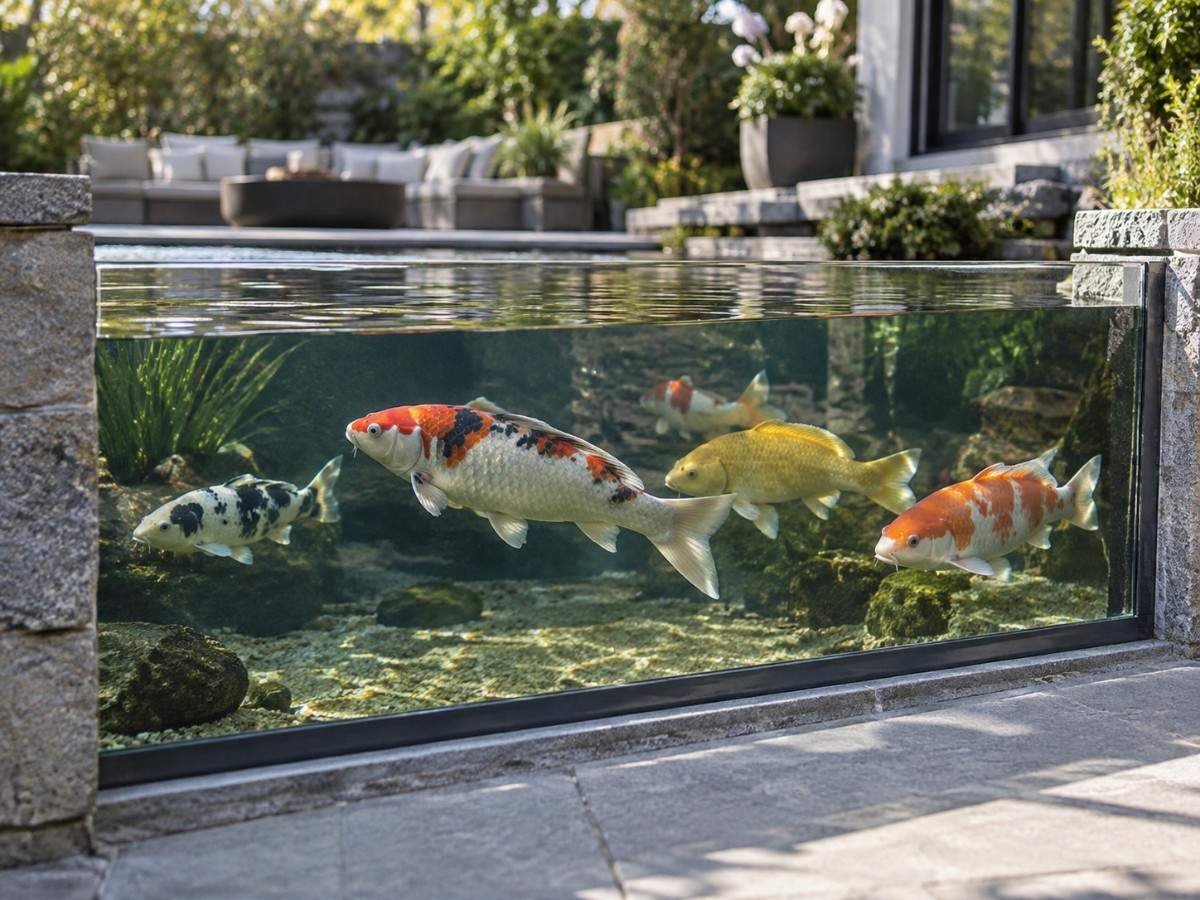
A viewing window lets you see koi from the side rather than only from above, which is a completely different experience of the same fish. The window is a cast acrylic panel set into the pond wall, and the pond is built around it.
This is the most technically demanding format we build. The panel has to be engineered for the water pressure at that depth, the seal has to be permanent and serviceable, and the surrounding structure has to carry the load without moving. Retrofitting a window into an existing pond is possible but rarely economical, so if you want one, decide before construction starts.
Viewing windows work particularly well where a pond sits alongside a seating area, a stairwell or a basement level, anywhere the side view can be seen from a place people naturally spend time.
The Construction Process, Stage by Stage
Every pond runs through the same sequence. The timeline changes with size and site, but the order does not, and skipping or compressing a stage is where most problems begin.
Site survey and design.
We look at the space, the soil, the water table, the drainage route, the power supply and where the filtration can physically go. Filtration location is decided at this stage, not later, because it determines pipe runs and levels for everything that follows.
Excavation and shell.
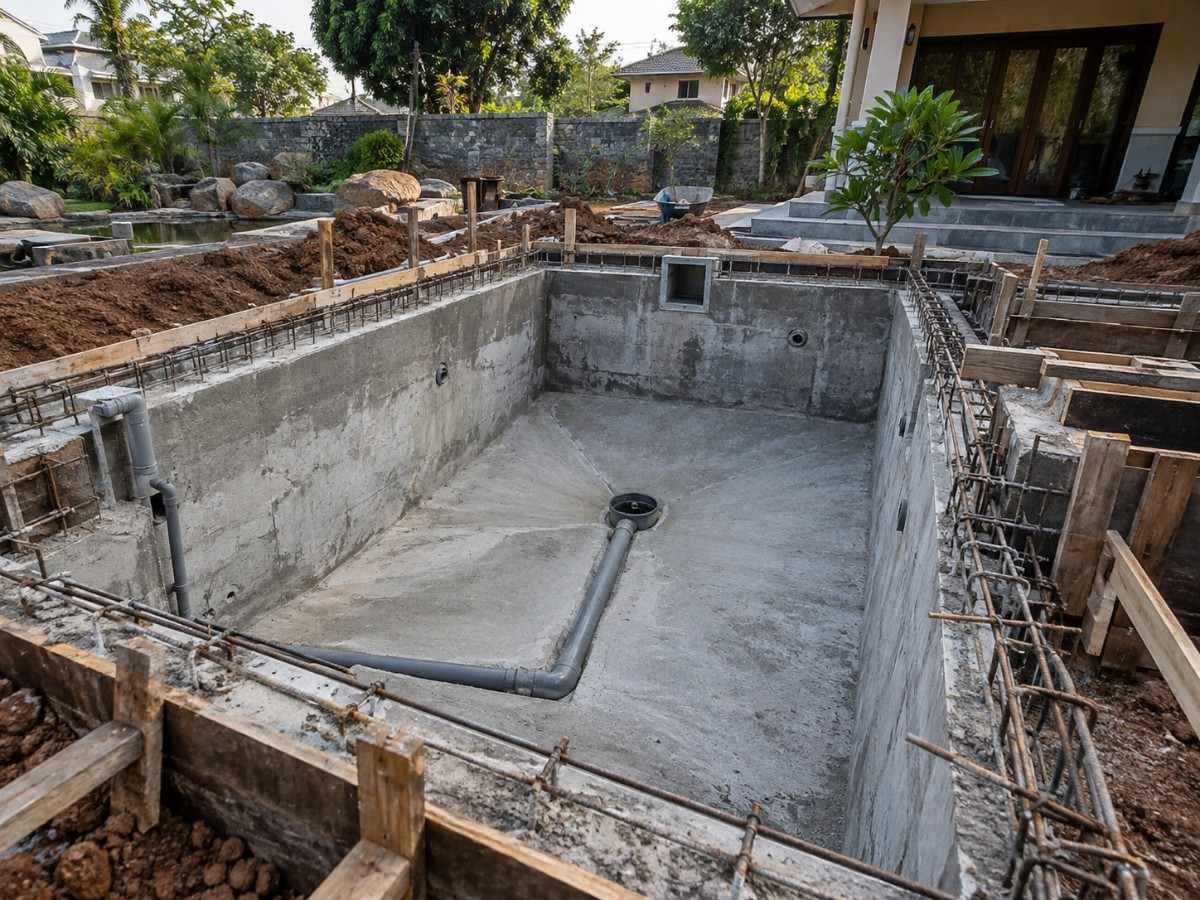
The pond is excavated to the design profile, with the floor sloped towards the bottom drain position. The shell is built, normally as a reinforced concrete structure for a permanent pond. Bottom drain and pipework are cast in at this stage. They cannot be added afterwards without breaking the shell.
Waterproofing.
Concrete is a structural material, not a waterproof one. Every concrete pond needs a separate sealing layer, and this is the single most common point of failure in ponds we are called to repair. We use a membrane or coating system appropriate to the shell, applied over a properly prepared surface and cured before filling.
Filtration installation.
Chambers are built or set, media installed, pump and UV fitted, and the whole circuit plumbed and tested for flow before the pond is finished around it.
Waterproofing test and first fill.
The pond is filled and held to check for leaks before any finish work, landscaping or planting goes in. Finding a leak after the stonework is laid is an expensive way to find a leak.
Finishes and landscaping.
Coping, cladding, waterfall construction, planting and lighting.
Cycling and stocking.
The filter has to grow its bacterial colony before the pond can carry fish. This takes several weeks and cannot be rushed. Koi are introduced in stages once the water is stable, not on completion day.
Depth, Size and Stocking for Indian Conditions
A koi pond in Chennai should be at least three to four feet deep, and deeper is better. This is the single most important number on this page, and it is where most locally built ponds go wrong.
The reason is temperature, not swimming space. Koi are comfortable between roughly 15°C and 25°C. Above about 28°C the water can no longer hold enough dissolved oxygen to meet what the fish and the filter bacteria are both demanding at once, and the pond moves from healthy to stressed. Chennai spends a long stretch of every year well above that air temperature.
A shallow pond tracks air temperature almost directly. A deep pond does not. Depth creates a cooler lower layer and slows the rate at which the whole body of water heats up, so the fish have somewhere to go and the daily swing is smaller. In a climate like ours, depth is thermal mass, and thermal mass is what keeps koi alive through April and May.
Depth also buys you water volume, and volume dilutes everything. Ammonia, nitrate, heat and any mistake you make are all less dangerous in a larger body of water. It is the most forgiving thing you can build into a pond.
Surface area matters too, because gas exchange happens at the surface. A pond that is deep but narrow will struggle for oxygen. The proportions need to work together, which is part of what design involves.
How Many Koi a Pond Can Hold
Fewer than you want. That is the honest answer, and the most common cause of water quality trouble in otherwise well built ponds.
A reasonable planning figure is around one koi per 1,000 litres of water for fish that will reach full size. Japanese lineage koi can reach 22 to 26 inches, and jumbo varieties go beyond that, so a pond stocked comfortably with six young fish can be badly overstocked by the same six fish four years later.
Stock for the fish you will have in five years, not the fish you are buying this month. An understocked pond is easy to run. An overstocked one is a permanent fight against water chemistry no filter fully wins.
If you want a lot of fish, the answer is a bigger pond or a larger filtration system specified for that load from the start, and we would rather have that conversation at design stage than after the pond is built.
Filtration That Actually Keeps Water Clear
This is the part that separates a pond that works from one that does not, and it is where we would ask you to compare us against anyone else you are considering.
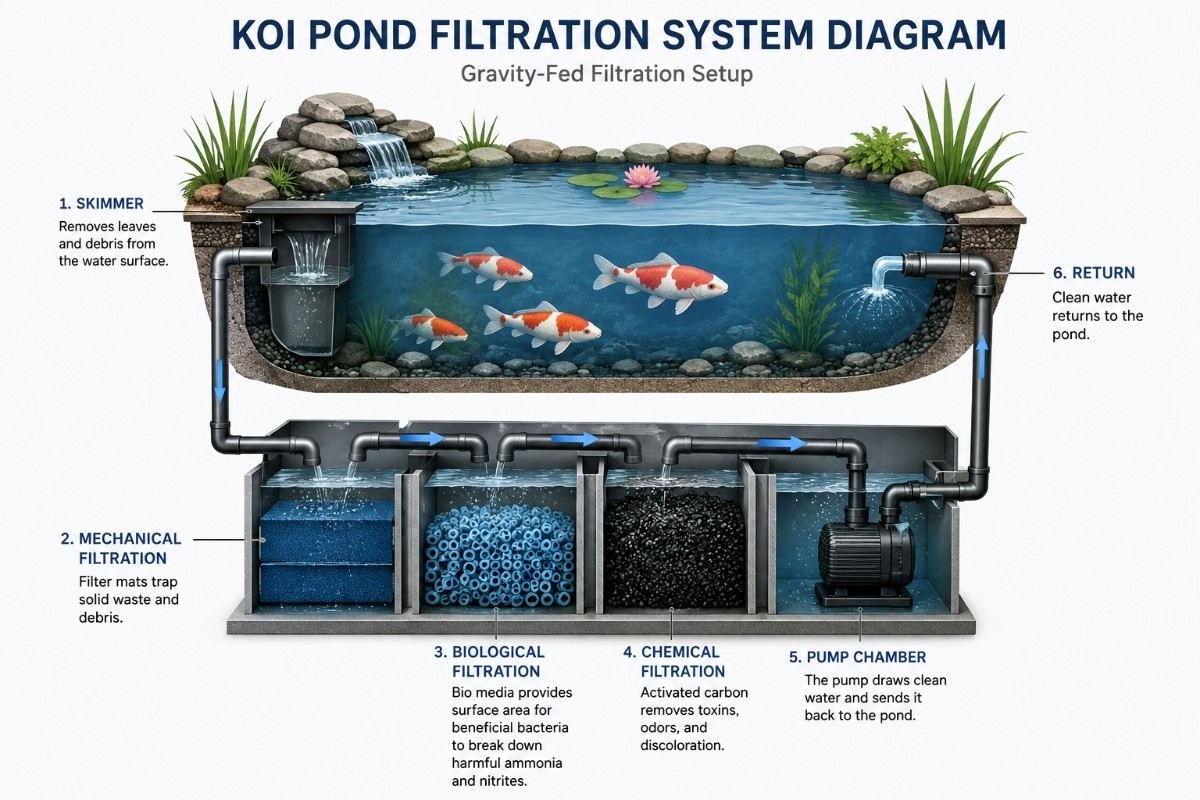
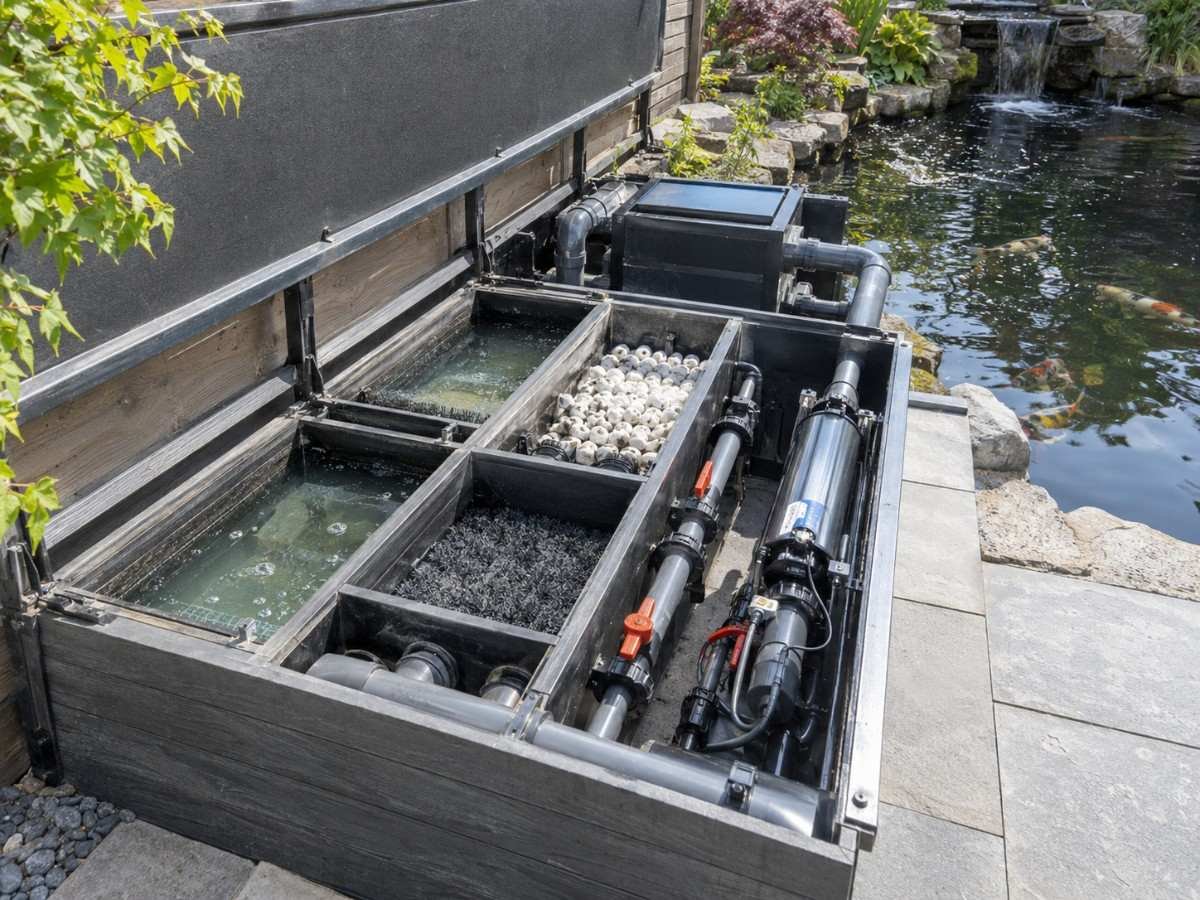
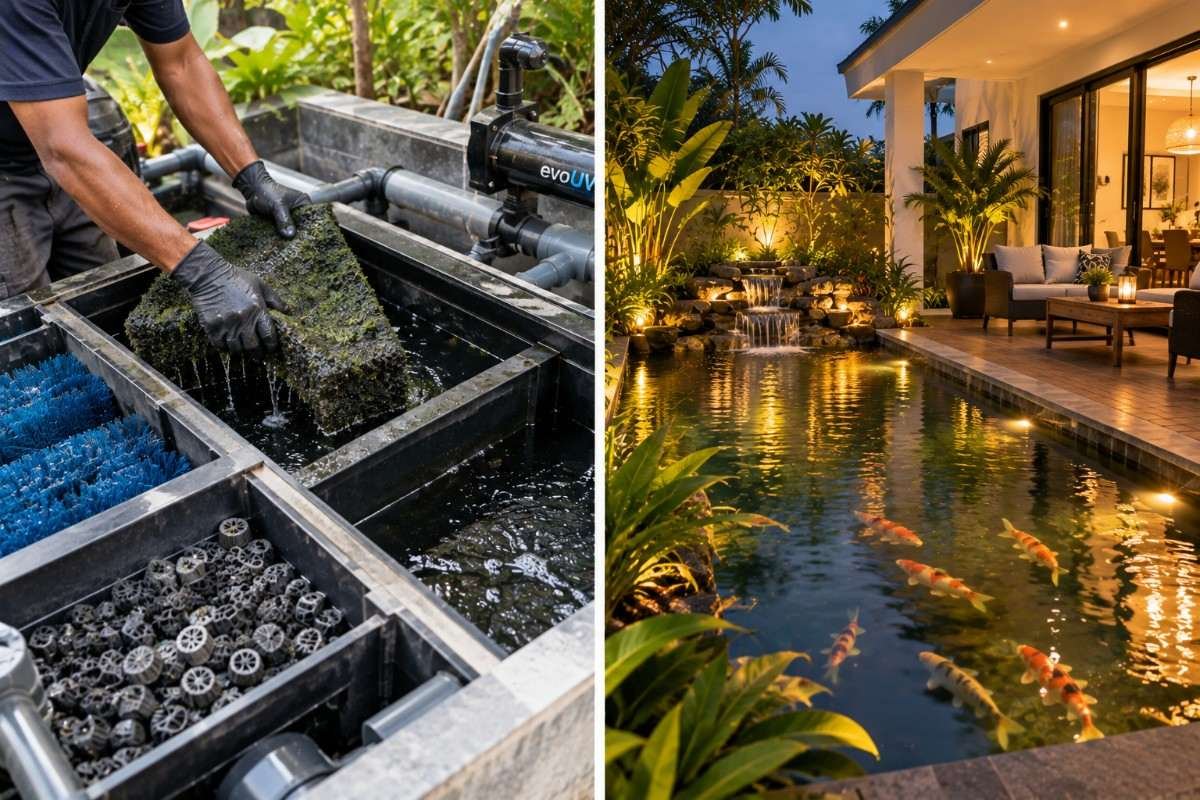
Mechanical filtration removes solid waste: fish waste, uneaten food, leaves, dust. This has to happen first, and it has to happen before the water reaches anything else. Solids that are allowed to break down in the pond become dissolved waste, and dissolved waste is far harder to remove than solid waste. This is why a settlement chamber sits at the head of a properly designed system, taking the heavy material out by gravity before any pump touches it.
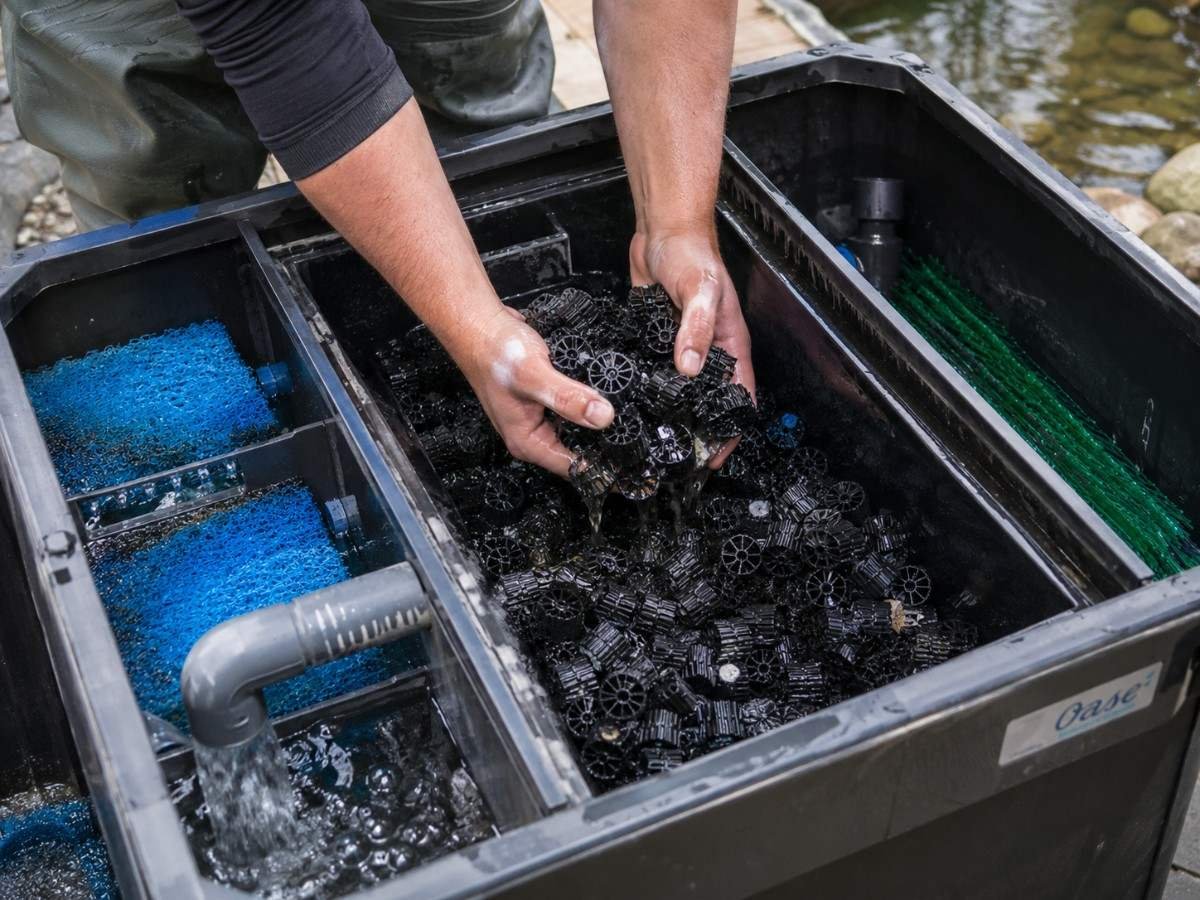
Biological filtration is the part most people do not see and most builders undersize. Fish produce ammonia continuously, and ammonia is toxic. In a mature filter, one population of bacteria converts ammonia to nitrite, which is also toxic, and a second converts nitrite to nitrate, which is largely harmless at pond concentrations and is taken up by plants or removed by water changes. That bacterial colony lives on the surface area of the filter media, and the amount of media you need is determined by how much you feed your fish, not by the volume of the pond.
Circulation and aeration run underneath both. The whole pond volume should pass through the filtration roughly once every one to two hours, faster if the pond is heavily stocked. Slower than that and waste sits in the pond instead of being removed. Aeration matters more here than in cooler countries, because warm water holds less oxygen precisely when the fish and the bacteria are both consuming more of it. A waterfall or a dedicated air pump is not decoration in this climate.
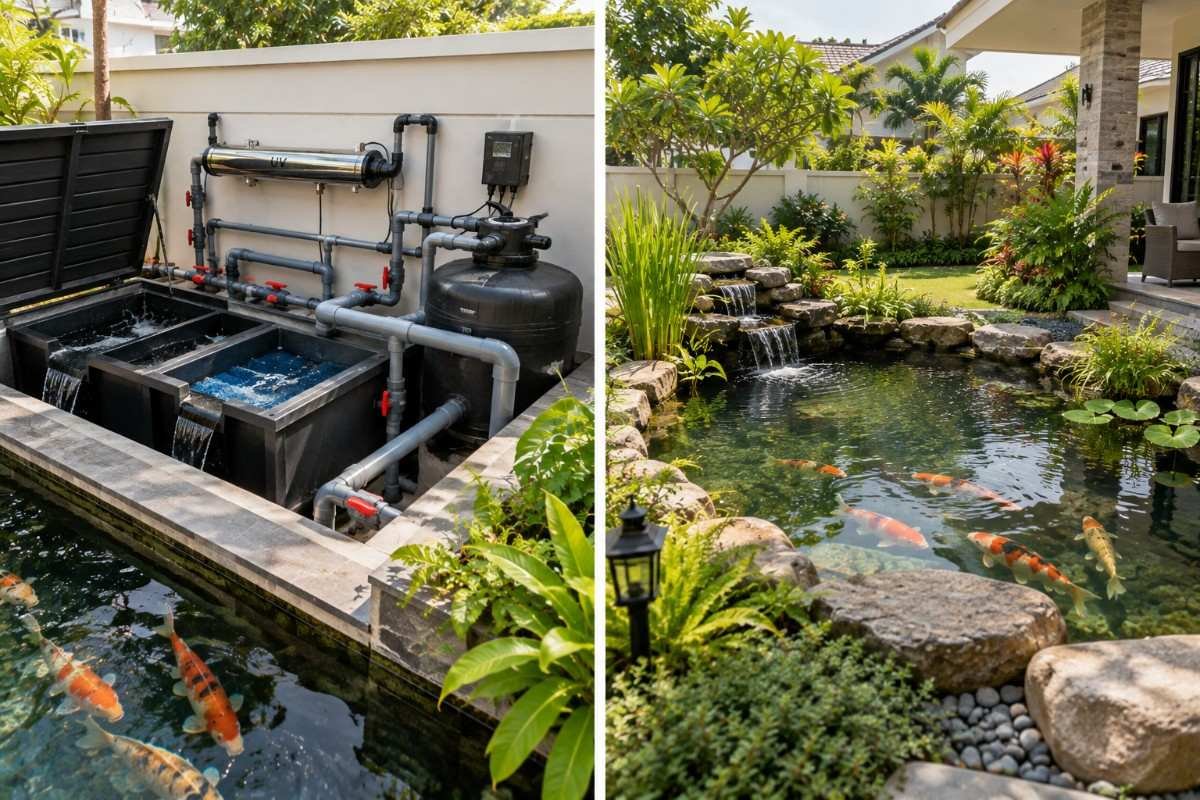
The order matters as much as the components. Water leaves the pond through a bottom drain at the lowest point, where waste naturally collects, and through a surface skimmer that takes floating debris. It passes by gravity through settlement, then mechanical, then biological stages. The pump sits at the end, after the solids have been removed, rather than at the beginning where it would shred waste into particles too fine for any filter to catch. Water then passes a UV clarifier and returns to the pond, usually through a waterfall that adds oxygen on the way in.
This is why two ponds of identical size can need very different biological filters. A lightly stocked pond fed sparingly needs a fraction of what a heavily stocked pond fed three times a day needs.
Clear water is not achieved by chemicals, by luck, or by changing the water frequently. It is the result of a correctly sized system doing three separate jobs continuously. Most ponds that fail in Chennai fail because someone bought a filter box rated for the pond volume, plumbed it in, and assumed that was filtration.
A pump-first system, which is what most cheap installations use, works against itself. It is the most common design error we find in ponds built by general contractors.
Why Ponds Turn Green
Green water is single-celled algae suspended in the water, and it blooms because there are more dissolved nutrients in the pond than the system is removing. It is a symptom of a nutrient imbalance, not a cleanliness problem, which is why scrubbing the pond and refilling it never fixes it for long.
The usual causes stack: too many fish, too much food, a biological filter too small for the load, and direct sunlight driving the growth. New ponds often go green in their first weeks simply because the bacterial colony has not established yet, and that particular case resolves itself.
A UV clarifier clears green water quickly, usually within three to ten days, by neutralising the algae cells as they pass through it. But UV treats the symptom. It does nothing to the underlying nutrient load, and a pond that needs its UV running constantly to stay clear has a filtration problem the UV is masking.
The durable fix is to correct the cause: right-size the biological filtration for the actual fish load, reduce feeding to what the fish clear in a few minutes, add planting to compete for nutrients, and shade the pond where it takes hard direct sun. We use UV as part of a properly sized system, not as a substitute for one.
If your existing pond goes green every summer, that is diagnosable and fixable, and it is covered further down this page.
What a Koi Pond Costs
Per square foot pricing is the wrong model for a koi pond, and quotes built that way are usually hiding something.
Two ponds with the same surface area can differ by several times in cost, because surface area says nothing about depth, nothing about the filtration system, and nothing about what the ground did when you started digging. A contractor quoting per square foot is either pricing a shallow ornamental pool, or intends to revise the figure once work starts.
What actually drives the number:
Volume, which means depth as well as area.
Depth adds excavation, structure and waterproofing across a larger surface, and it multiplies the water you have to filter.
The filtration system.
The widest variable on the list. A modest system for a lightly stocked garden pond and a full gravity-fed system with drum filtration, a large biological stage and UV are very different figures, and the second is what a serious koi pond needs.
Site conditions.
Rock, a high water table, poor access for machinery, or a site where everything has to be carried by hand all change excavation cost before anything is built.
Structure and waterproofing specification.
This is the last place to economise. The cost of doing it properly is a fraction of the cost of emptying a stocked pond in two years to fix a leak.
Features.
Waterfalls, acrylic viewing windows, lighting, coping and cladding, planting. A viewing window in particular is a significant addition.
The fish.
Koi range from ordinary to extraordinary in price, and this is the one line you control completely. Quality koi from good lineage cost what they cost, and there is no obligation to stock at that level on day one.
Running cost is worth planning too. The pump runs continuously, so pump efficiency has a real effect on your monthly electricity, and a gravity-fed system draws noticeably less than a pressurised one for the same result.
Send us the space and roughly what you want, and we will quote a complete system.
How Long It Takes
Construction time depends on size, site and features, and we confirm it at quotation. What does not vary is the biology at the end.
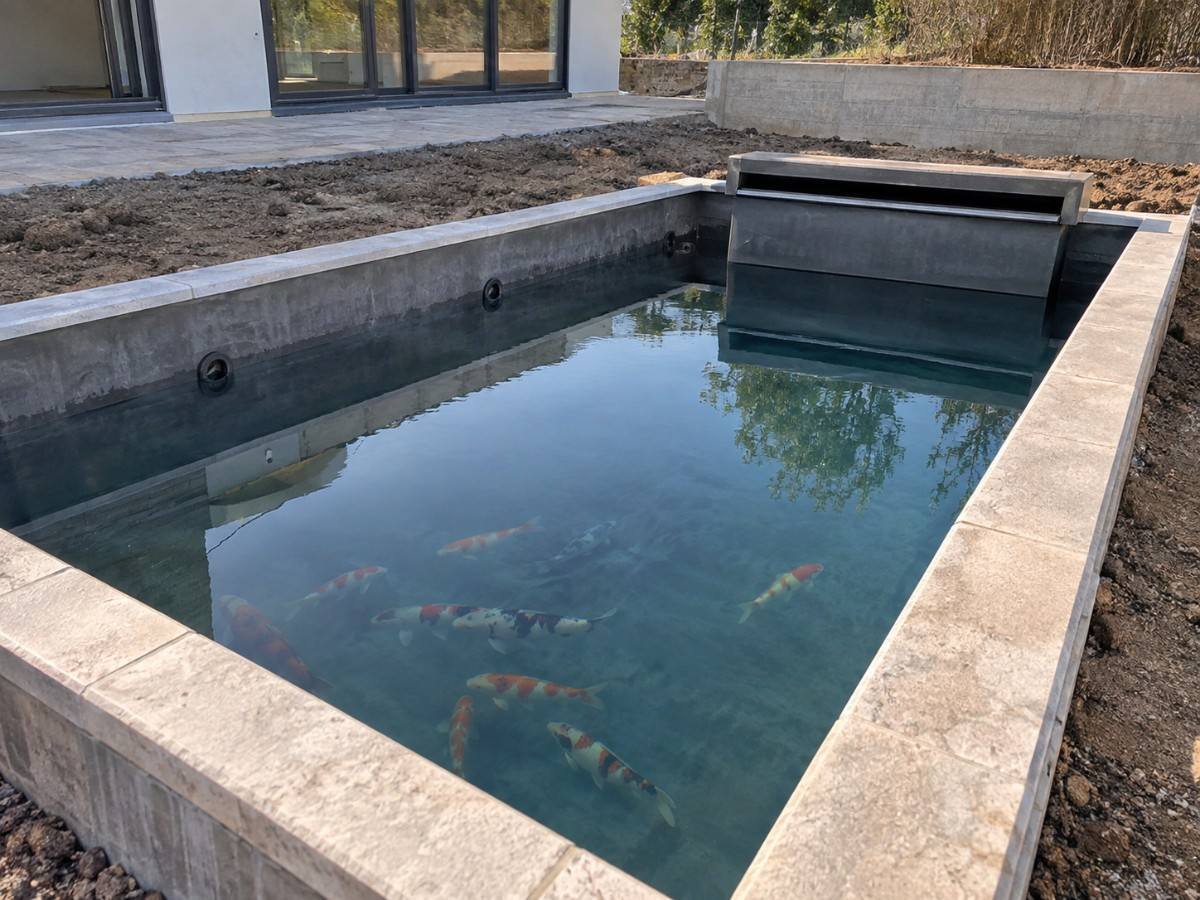
The build itself, from excavation to filled and running, is typically a matter of weeks rather than months for a domestic pond. Waterproofing and its curing time set a floor on how fast the shell stage can go, and rushing that is the single worst economy available in pond building.
After the pond is filled and circulating, the filter needs to cycle. The bacterial colony that processes ammonia has to establish itself on the media, and that takes several weeks in warm water. Koi are added gradually across that period, with water tested as you go, rather than all at once at the end.
Plan the project around the stocking date, not the completion date. A pond can look entirely finished a month before it should be carrying a full fish load.
Fixing a Poorly Built Pond
A significant share of our pond work is repairing ponds built by someone else. If yours leaks, goes green every summer, loses fish without explanation or has never really been clear, it is usually fixable without demolition.
The problems repeat, and they are nearly always one of five things.
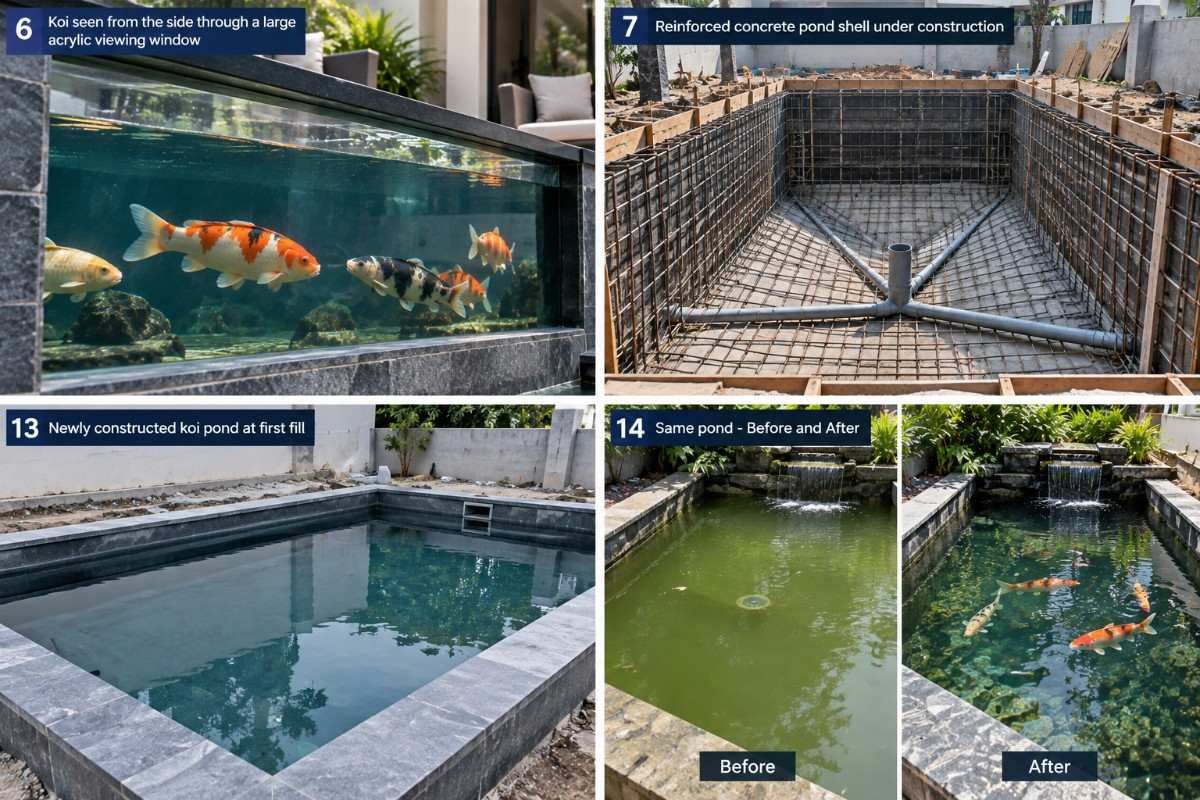
No bottom drain.
Waste settles on the floor and stays there, decomposing. Ponds built without one rely on a pump hanging in the water, which never clears the floor. Retrofitting a true bottom drain means breaking the shell, so the practical fix is usually a combination of improved circulation and a different approach to floor cleaning.
Waterproofing failure.
Concrete was poured and left unsealed, or sealed with the wrong product. Symptoms are a steadily dropping water level and damp appearing outside the pond. Repairable by draining, preparing and recoating properly.
Wrong depth.
The hardest to fix, because it is structural. A two foot pond in Chennai will always struggle in summer. Sometimes the shell can be deepened, sometimes the honest answer is that the pond suits ornamental fish rather than koi, and we will say so.
Pump-first plumbing.
The pump sits before the filtration and shreds solids before they can be removed. Re-plumbing to a gravity-fed layout is disruptive but usually possible.
We start with an assessment: water testing, a look at the filtration and plumbing, and an inspection of the shell. You get a written account of what is wrong and what each fix involves, including the ones we think are not worth doing. Refurbishing a sound pond with a bad filter costs a fraction of rebuilding, and we would rather tell you that than sell you a new pond.
Waterfalls, Landscaping and Integration
A waterfall is the one feature that is both decorative and functional. Falling water drives gas exchange, which is exactly what a warm pond needs, so a well designed cascade is doing real work for the fish while it does the visual work for you.
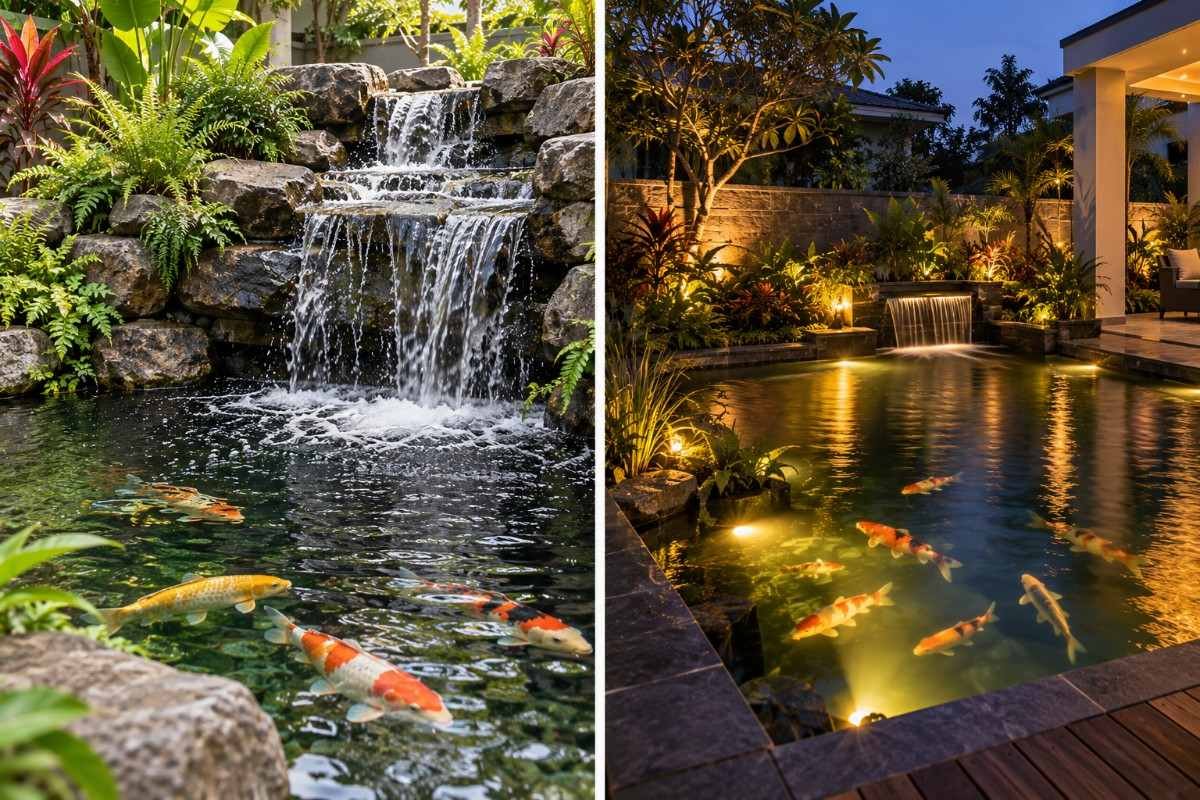
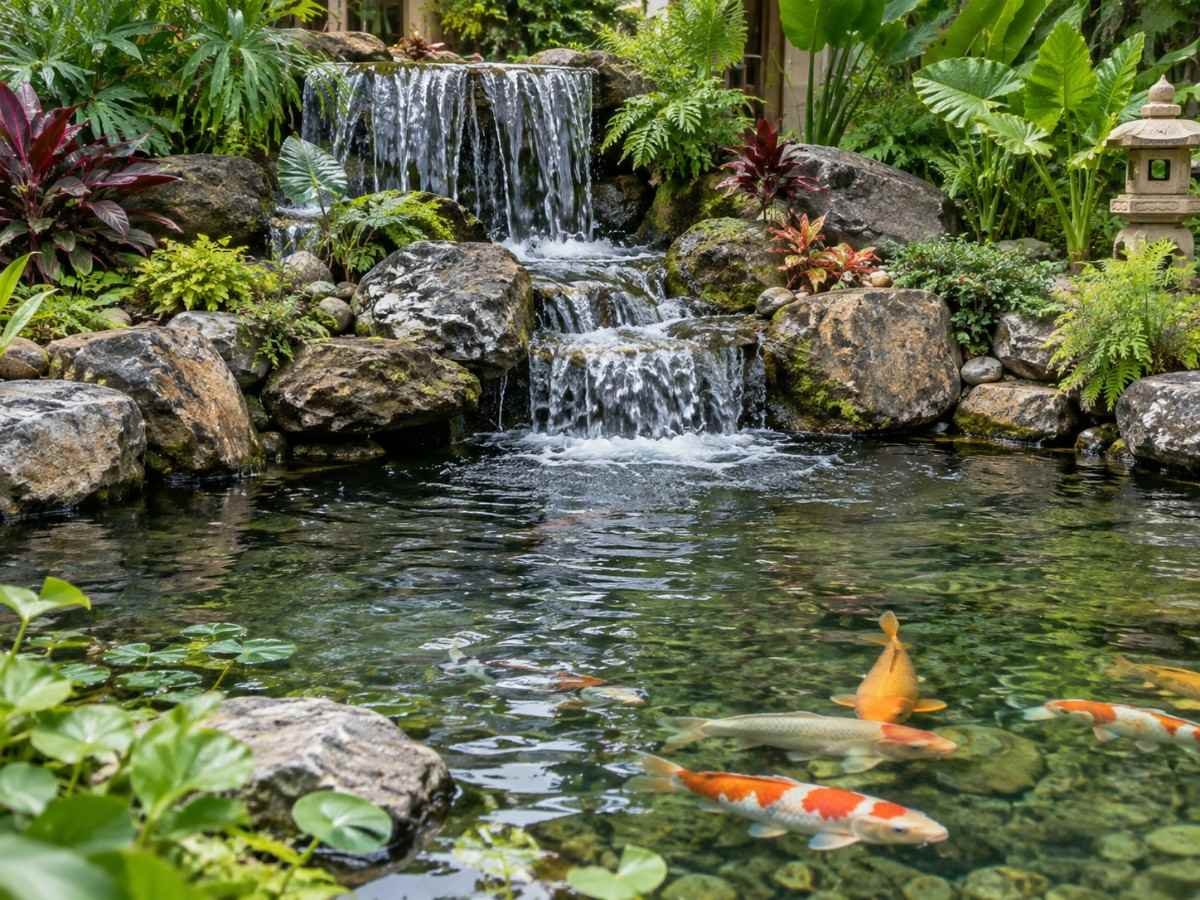
Scale it to the filtration rather than to the drama. An oversized waterfall run from an undersized pump starves the filter of flow, and a very large fall increases evaporation, which in a Chennai summer means noticeably more top-up water.
Around the pond, planting does more than soften the edges. Marginal and floating plants compete with algae for the same dissolved nutrients and provide shade that reduces direct sun on the water. Lilies are the usual choice for surface cover, though koi will graze them, so planting baskets need protecting in a stocked pond
Coping and edge detailing decide how the pond reads. A raised edge at seating height turns a pond into a place people gather, which is usually worth more than a few extra square feet of water. Lighting extends the pond into the evening and is far easier to install during construction than after.
If the pond sits in a landscape scheme someone else is designing, we are happy to work alongside them. Send drawings and we will return the pond's dimensions, levels, service requirements and filtration chamber footprint for coordination.
Ongoing Care and Maintenance
A well built pond is not demanding, but it is not unattended either.
Weekly attention means checking the fish, clearing the skimmer basket and watching that flow rates look normal. Monthly means cleaning mechanical media, checking water parameters and topping up. Biological media should be rinsed in pond water rather than tap water, because chlorinated water kills the bacterial colony you spent weeks growing.
Chennai adds two seasonal jobs. Through summer, evaporation rises and oxygen falls, so top-ups are more frequent and aeration matters more. Through monsoon, runoff can carry debris and change water chemistry quickly, and the surrounding area needs to drain away from the pond rather than into it.
We offer scheduled maintenance for ponds we have built and for ponds we have not. For commercial installations we would recommend it as standard, because a lobby or restaurant pond that is not on a contract will look poor within months and the fish are the first thing to suffer.
If you would rather run the pond yourself, we will hand it over properly and show you what to watch.
Start Your Pond Project
Tell us the space you have and what you would like in it. For sites in and around Chennai we will visit and survey it ourselves. For projects elsewhere in South India, we can begin from photographs, dimensions and drawings.
You will get a design, a filtration specification and a quotation for the complete system rather than a price for a hole with a pump in it.
If you have a pond that is not working, ask for an assessment instead. Most of them are worth fixing.
Frequently Asked Questions
How much does koi pond construction cost in Chennai?
There is no reliable per square foot figure, because surface area does not determine pond cost. Depth, filtration specification, site conditions, waterproofing and features all move the number more than area does. A shallow ornamental pool and a properly filtered koi pond of the same footprint are very different projects. Send us the space and your intentions for it, and we will quote the complete system.
How deep should a koi pond be?
At least three to four feet in Chennai, and deeper if the site allows. Depth is about temperature rather than swimming space. Koi are comfortable between roughly 15°C and 25°C, and above about 28°C the water cannot hold enough dissolved oxygen for the fish and the filter bacteria together. A deep pond heats more slowly, holds a cooler lower layer and swings less between day and night, which is exactly what koi need through a Chennai summer.
Can a koi pond be built indoors?
Yes, and indoor ponds work well in entrances, atriums and lobbies. They are usually raised or partially raised rather than excavated, the filtration has to be concealed and quiet, and humidity and splash need planning. Indoor ponds can run slightly shallower than outdoor ones because they avoid direct sun and hold a steadier temperature, but they still need genuine depth for the fish.
Should a koi pond be concrete or liner?
Concrete and liner are not really alternatives, because they do different jobs. Concrete is structural and will crack eventually, so it always needs a separate waterproofing layer over it. A liner is a sealing layer with no structural capacity of its own. For a permanent koi pond we build a reinforced concrete shell and seal it with an appropriate membrane or coating system, which gives structural permanence and a reliable seal. Liner-only ponds are quicker and cheaper and suit smaller ornamental ponds, and a leak in one is easier to find and patch.
Why is my koi pond water green?
Green water is suspended single-celled algae, blooming because dissolved nutrients in the pond exceed what the filtration removes. The usual causes are overstocking, overfeeding, an undersized biological filter and direct sunlight, and they usually occur together. A UV clarifier will clear it within three to ten days, but UV treats the symptom rather than the cause. A pond that only stays clear while the UV runs has a filtration problem underneath. New ponds often go green briefly while the filter establishes, which resolves on its own.
How long does it take to build a koi pond?
The build is usually weeks rather than months for a domestic pond, with waterproofing and its curing time setting the pace. After filling, the filter needs several weeks to establish its bacterial colony before the pond can carry a full fish load, and koi are introduced gradually across that period. Plan around the stocking date rather than the completion date.
How many koi fish can a pond hold?
Plan for roughly one koi per 1,000 litres for fish at full size. Japanese lineage koi reach 22 to 26 inches and jumbo varieties exceed that, so stock for the fish you will have in five years rather than the size they are when you buy them. Overstocking is the most common cause of water quality problems in otherwise well built ponds, and an understocked pond is far easier to keep clear.
Do koi ponds attract mosquitoes?
A properly built koi pond does not breed mosquitoes. Mosquito larvae need still water, and a pond with continuous circulation, aeration and a waterfall does not provide it. Fish also predate larvae. Neglected ponds with stagnant corners, dead flow zones or a pump left off can breed mosquitoes, which is a maintenance and design issue rather than something inherent to having a pond.
How much does a custom aquarium cost in Chennai?
Yes, and it is one of the most popular options in Chennai homes, particularly between the hall and the dining area. The opening needs to be sized for the tank plus the frame and service clearance, the sill has to carry the load, and the plumbing and power must be routed to the sump location before the masonry is finished. It can be retrofitted into a finished wall, but it is considerably easier and cheaper when planned during construction.
Do you design aquariums specifically for homes?
Yes. Residential aquarium design can be planned for living rooms, feature walls, entrances, villas and other interior spaces. Placement, scale and maintenance access should be considered from the start.
Can you install aquariums for offices, hotels and restaurants?
Yes. Commercial aquarium projects need both visual impact and dependable day-to-day operation. The design should consider viewing traffic, service access and a realistic maintenance plan.
Should I choose acrylic or glass for my aquarium?
The right material depends on the size, shape, visual requirement, location and budget. For larger or highly customised installations, acrylic may be worth considering; for other projects, glass may be more practical. The material should be selected as part of the design process.
Do you build koi ponds from scratch?
Yes. A koi pond project can include pond planning, construction approach, water circulation, filtration and the ongoing maintenance strategy needed for healthier fish and more stable water conditions.
Do I need permission to build a pond at home?
An ornamental pond within your own property is normally treated as a landscape feature rather than a construction requiring separate approval, but this is not something to take on trust. Rules vary between local bodies, and apartment complexes and gated communities almost always need association approval for work of this kind. If your pond involves significant excavation near a boundary or an existing structure, check with your local authority first. We can tell you what a given design involves structurally, but we are not the right people to advise on approvals in your locality.
Do you build ponds outside Chennai?
Chennai is our base and where we survey sites directly. We also take pond projects across Tamil Nadu and South India. For projects outside Chennai, the design stage works from drawings, photographs and dimensions, with site visits scheduled for survey and installation.

Designs, builds and maintains custom aquariums, koi ponds and aquatic features with a focus on thoughtful engineering and long-term care.
SUBSCRIBE FOR UPDATE
©Living Art Aquarium 2026. All rights reserved.